Author: Jude Chartier
In an age defined by digital noise and sensory overload, we are constantly sold ‘life hacks’ and minimalist trends as quick fixes for a scattered mind. We buy planners to organize chaos we haven’t yet understood, and download apps to manage distractions created by other apps. However, these are merely symptomatic treatments for a deeper, existential ailment. The true cure for modern chaos lies not in a new piece of software, but in the timeless blueprints of the soul provided by history’s greatest thinkers. The most profound philosophers—from the Stoic emperors of Rome to the Taoist sages of ancient China—viewed the environment not as a mere container for life, but as a direct, pulsating extension of the human spirit.
To create order in your physical and digital space is to build an “Inner Citadel” where wisdom can finally take root. When your environment exists in a state of entropy, your mind is forced to spend its limited cognitive “currency” simply navigating that chaos. This is not merely a matter of aesthetics or “tidiness”; it is a matter of psychological survival and spiritual clarity. By applying the essence of wisdom to our surroundings, we stop fighting our environment and start using it as a launchpad for a flourishing life.
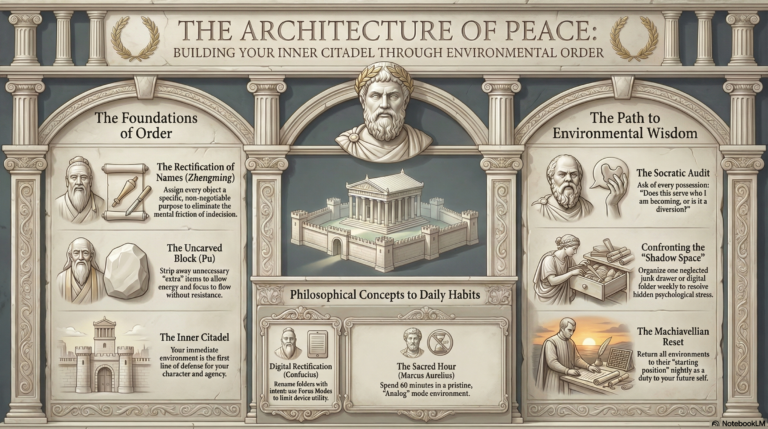
The Rectification of Space: Names, Places, and Digital Hygiene
Confucius taught the principle of Zhengming (The Rectification of Names). He argued that if names are not correct, language is not in accordance with the truth of things. If language is not in accordance with the truth, affairs cannot be carried on to success. In a well-ordered society, a “King” must act like a king, and a “Father” like a father. When names lose their meaning, boundaries dissolve, and society falls into ruin.
The Law of Function
Apply this to your physical world. If a surface is designated as “a desk,” it must be fit for work. If a corner is for “rest,” it should not be a graveyard for half-finished projects or unfolded laundry. When we allow a kitchen table to become a filing cabinet, we are committing a “naming error” that confuses the brain. Every time you look at a multi-purpose mess, your brain must perform a micro-calculation: Is this for eating or for taxes? This “cognitive switching cost” may seem negligible in isolation, but over the course of a day, it drains the mental energy required for deep, analytical thought. By “rectifying” your space—assigning every object and area a specific, non-negotiable purpose—you eliminate the mental friction of indecision. This is the first step toward Intellectual Integrity, as Socrates might suggest: ensuring your outward environment is as honest and coherent as your inward logic. When your environment is “rectified,” your subconscious doesn’t have to guess what behavior is expected of it; the room itself dictates the intention.
The Digital “Zhengming”
Our digital environments are the frontier of modern entropy. We treat our smartphones as a “Swiss Army Knife” of existence, but unlike a physical tool, every “blade”—from urgent work emails to dopamine-inducing social feeds—is open simultaneously. This leads to “Context Collapse,” a state where the boundaries between our professional, social, and private selves dissolve. The mind is left in a perpetual state of low-level alarm, unable to commit fully to any single mode of being.
Essence of Wisdom Tip: Perform a “Digital Rectification.” Rename your folders and apps with brutal intention. If a folder is titled “Work,” remove everything—even the “helpful” utilities—that isn’t active work. Use “Focus Modes” on your phone to rectify the device’s purpose based on the time of day—turning a “distraction machine” back into a “precise tool.” This mirrors the Socratic commitment to the Elenchus (questioning the essence): ensure that what you call a tool is actually functioning as one, rather than as a hidden master of your time.
The Uncarved Block: Stripping to the Essence
Lao Tzu spoke of Pu (The Uncarved Block), representing a state of pure potentiality before it is cluttered by human artifice or unnecessary decoration. In Taoism, the utility of a room comes from the space within the walls; the utility of a bowl comes from its emptiness. We often focus on the “stuff” (the walls and the clay), while the “wisdom” lies in the space (the emptiness) that allows for movement and use.
Environmental Wu Wei
Wu Wei is “effortless action,” or the art of sailing with the wind rather than rowing against it. Imagine a river flowing around a smooth stone; that is Wu Wei. Now imagine a river trying to flow through a pile of jagged debris, sharp plastic, and tangled weeds; that is our modern life. A cluttered room or a desktop full of random icons are “snags” in the river of your day. They are micro-distractions that catch your attention, snag your focus, and create an invisible “friction” that makes even simple tasks feel exhausting.
By stripping away the “extra” and returning to the simplicity of the uncarved block, you create an environment where your energy can flow without resistance. This isn’t about owning nothing; it’s about owning only what allows for Fluidity. If an object doesn’t help you flow, it is a dam. True simplicity is not just the absence of clutter, but the presence of purpose.
The Modern Stressor: Divertissement
Blaise Pascal famously warned that “all of humanity’s problems stem from man’s inability to sit quietly in a room alone.” He called our escape from this silence Divertissement (diversion). In the modern world, this manifests as the “phantom itch” to check a notification or the habit of keeping forty browser tabs open. These aren’t just tools; they are a fortress of clutter built to shield us from the discomfort of self-reflection. We hoard information and objects to convince ourselves we are too busy to be existential. Clutter is the physical noise we use to drown out the “Infinite Silence” that Pascal so feared—the silence that forces us to ask if our lives have meaning.
Essence of Wisdom Tip: Practice “The Socratic Audit.” Pick up an object or look at a bookmarked website and ask: “What is this? Does it serve the person I am becoming, or is it a diversion from the person I am?” This is the application of the Elenchus to your possessions. If an item is merely a prop to make you feel busy or safe without providing actual value, it is a shadow on the wall of the cave. Let it go to find the light of true priority.
The Inner Citadel and the Digital Wall
Marcus Aurelius and Epictetus focused on the Inner Citadel, the fortress of the mind that remains calm while the world outside burns. However, they were also pragmatists who lived in the physical world. They understood that while we should be internally indifferent to externals, our “Outer Wall”—our immediate environment—is the first line of defense for our character. If the wall is breached by constant notifications and physical disarray, the fortress is much harder to defend.
The Dichotomy of Control
The modern world is a tempest of chaos; you cannot control the economy, the news, or the social media algorithms designed by thousands of engineers to harvest your dopamine. However, you have absolute sovereignty over your immediate square footage and your notification settings. Ordering your environment is the first and most basic exercise of your Prohairesis (Moral Choice). To leave your environment in shambles is to effectively cede your territory to the forces of entropy. It is a surrender of the only thing you truly own: your agency. Stoic fortitude begins with the discipline of the small—the bed made, the desk cleared, the inbox emptied.
The Space for Response
Viktor Frankl famously noted that our freedom lies in the “space between stimulus and response.” In that space lies our growth and our happiness. A visual mess or a buzzing phone is a constant, aggressive stimulus. It demands a response now. It shortens the fuse of your patience and narrows the window of your perspective. By clearing your physical desk and silencing non-essential digital pings, you are literally expanding that “space.” You move from a state of reaction (the animal brain) to a state of intention (the human soul). Order provides the margin required for meaning to emerge.
Essence of Wisdom Tip: Designate a “Sacred Hour.” For sixty minutes a day, your physical environment must be pristine, and your digital environment must be “Analog” (airplane mode). This is your daily retreat into the Inner Citadel, allowing your Daimonion—that inner voice of wisdom Socrates followed—to finally be heard above the din of the marketplace. This practice builds the “mental muscle” required to stay centered when the external world becomes truly unmanageable.
Confronting the Shadow in the Junk Drawer
Carl Jung believed that the parts of ourselves we ignore or repress—the Shadow—don’t simply vanish; they manifest as external problems, chronic stress, or “bad luck.” Our environment is a canvas for our Persona—the image we want the world to see—while our “Shadow” hides in the corners we neglect.
The Act of Individuation
We all have a “junk drawer,” a “shame closet,” or a “Downloads” folder that has become a digital landfill. These are more than just untidy spaces; they are physical manifestations of avoided responsibilities, unmade decisions, and “unintegrated” parts of our lives. Every unread PDF and every stack of unopened mail is a piece of your energy trapped in the Shadow. Confronting these “digital landfills” is an act of Individuation.
Leon Festinger explained this through Cognitive Dissonance: the psychological pain we feel when our actions (living in chaos) contradict our self-image (being a person of wisdom). When you organize the neglected corners of your home, you are bringing the “dark” parts of your existence into the light of conscious order. You are reclaiming the energy those avoided tasks have been draining from you. This is the process of making the unconscious conscious through the act of sorting, discarding, and deciding.
Essence of Wisdom Tip: Tackle one “Shadow Space” per week. Whether it is the trunk of your car, the “Misc” folder on your desktop, or your email inbox, bring it into order. Notice the psychological “lightness” that follows; this is the resolution of dissonance. By cleaning these spaces, you are “Willing One Thing,” as Kierkegaard suggested, achieving a Purity of Heart that comes from aligning your external reality with your internal values.
Designing for Eudaimonia and Flow
Finally, we use order as a tool for Eudaimonia (Flourishing). Aristotle argued for the Doctrine of the Mean—virtue is the balance between two extremes. In the context of our environment, order is the virtuous mean between the “Deficiency” of entropy (a life in shambles) and the “Excess” of sterile perfectionism (a life too rigid to be lived). Order is not an end in itself; it is a servant to life.
The Biofeedback of Flow
Mihaly Csikszentmihalyi noted that Flow—that state where time disappears and you are one with your work—requires clear goals and immediate feedback. An ordered environment acts as a biofeedback loop. When every tool has a place, you don’t have to break your concentration to find what you need.
Niccolò Machiavelli spoke of the “Lion and the Fox”—the need for both strength and strategic craftiness. A well-ordered environment is your Strategic Efficacy. It allows you to be the Lion (undistracted strength) because you have been the Fox (crafty organization). When your physical and digital “pipelines” are clear, your skill can perfectly meet the challenge at hand, fulfilling the top of Abraham Maslow’s Hierarchy: Self-Actualization. You cannot reach the peak of human potential if you are still tripping over the bottom rungs of basic environmental needs.
The Categorical Imperative of the Home
Immanuel Kant suggested we should act as if our actions were to become universal law. Treat your environment with that level of gravity. Every time you leave a dish in the sink or a tab open, you are voting for a world of entropy. You are saying, “It is okay for things to be left undone.”
If the way you kept your desk became the “universal law” for the world, would that world be one of clarity or one of confusion? By maintaining order, you are practicing a “Moral Duty” to the future version of yourself who will inhabit that space. This is the ultimate expression of Sympatheia—the Stoic recognition that we are all connected across time. Your present self is the guardian of your future self’s peace.
Essence of Wisdom Tip: Implement “The Machiavellian Reset.” At the end of every day, return your environment (both physical and digital) to its “starting position.” Close every tab, clear every surface, and empty the trash. This ensures that tomorrow’s version of you inherits a kingdom of order rather than a battlefield of yesterday’s remains. This is the Leap of Faith Kierkegaard described—acting now for a future benefit you cannot yet see, trusting that order today will yield wisdom tomorrow.
Conclusion: The Sovereignty of Context
When we synthesize the teachings of these 15 profound thinkers, a single, dominant theme emerges: The Sovereignty of Context. While we may lack control over the vast machinations of the universe, we are the absolute architects of the immediate environment that shapes our minds.
Order is not a sterile end-state, but the vessel that allows wisdom to be poured into your life. It is the architectural foundation upon which the “Good Life” is built. From the Socratic demand for integrity to the Lao Tzu‘s call for fluidity, we see that environmental management is actually Prohairesis—moral choice—in action. By rectifying your names, carving your blocks, and fortifying your citadel, you resolve the Cognitive Dissonance of a chaotic life and clear the path for Flow, Eudaimonia, and Self-Actualization.
The common thread is simple yet transformative: You cannot think clearly in a room that is screaming for your attention. By taking the Leap of Faith and implementing these strategies, you fulfill your Duty to yourself. You move from being a victim of your surroundings to the strategic Lion and Fox of your own domain.
Start small. Close one tab. Clear one shelf. Rectify one name. In the quiet, intentional rhythm of an ordered environment, you create the “Space” necessary to hear the whisper of your Daimonion guiding you toward your true purpose.
Essence of Wisdom: Practical Tips Summary
| Tip Name | Core Philosopher / Concept | Practical Action | Psychological Benefit |
| Digital Rectification | Confucius (Zhengming) | Rename folders with brutal intent; use “Focus Modes” to limit device utility by time of day. | Eliminates “Context Collapse”; provides immediate clarity on the device’s current role. |
| The Socratic Audit | Socrates (Elenchus) / Pascal | Pick up an object or link and ask: “Does this serve the person I am becoming, or is it a diversion?” | Breaks the cycle of Divertissement (distraction); aligns possessions with true identity. |
| The Sacred Hour | Marcus Aurelius / Viktor Frankl | 60 minutes of a pristine physical environment and “Analog” (Airplane Mode) digital status. | Expands the “Space between Stimulus and Response”; strengthens the Inner Citadel. |
| Shadow Space Cleanup | Carl Jung / Leon Festinger | Tackle one “neglected” area per week (e.g., junk drawer, Downloads folder, car trunk). | Resolves Cognitive Dissonance; facilitates Individuation by making the unconscious conscious. |
| The Machiavellian Reset | Machiavelli / Immanuel Kant | Every evening, return all environments (physical and digital) to a “starting position” for the next day. | Ensures Strategic Efficacy; fulfills the “Categorical Imperative” or duty to your future self. |
How to Use This Chart
- Daily: Perform the Machiavellian Reset to ensure every morning begins with order.
- Weekly: Select one Shadow Space to integrate back into your conscious order.
- In-the-Moment: Use the Socratic Audit when tempted to buy a new object or bookmark a distracting site.
Further Reading & References
To deepen your understanding of these principles, the following works serve as the foundation for this philosophy of ordered living:
- Marcus Aurelius, Meditations: The definitive guide for the concept of the Inner Citadel and maintaining composure amidst external chaos.
- Lao Tzu, Tao Te Ching: Essential reading for understanding Wu Wei and the power of simplicity (Pu).
- Viktor Frankl, Man’s Search for Meaning: A profound look at the vital importance of creating “space” for human agency under extreme pressure.
- Mihaly Csikszentmihalyi, Flow: The Psychology of Optimal Experience: Explains the connection between structured environments and high-performance states.
- Confucius, The Analects: On the importance of Zhengming (Rectification of Names) and the role of ritual (Li) in daily life.
- Carl Jung, Modern Man in Search of a Soul: Provides the framework for understanding the Shadow, the Persona, and the process of Individuation.
- Blaise Pascal, Pensées: A haunting exploration of Divertissement and our tendency to use clutter as an escape from the self.
- Leon Festinger, A Theory of Cognitive Dissonance: The psychological basis for the mental discomfort caused by a disordered environment.
- Aristotle, Nicomachean Ethics: For the Doctrine of the Mean and the definition of Eudaimonia as an active life of virtue.
- Epictetus, Enchiridion: The handbook for the foundational understanding of the Dichotomy of Control and Prohairesis.
- Immanuel Kant, Groundwork of the Metaphysics of Morals: For the exploration of Duty and the Categorical Imperative.
- Niccolò Machiavelli, The Prince: For the metaphors of strategic efficacy and the “Lion and the Fox.”
- Søren Kierkegaard, Purity of Heart is to Will One Thing: On the spiritual necessity of focus and the “Leap of Faith.”
- Abraham Maslow, Toward a Psychology of Being: For the Hierarchy of Needs and the environmental prerequisites for Self-Actualization.
- Plato, The Apology of Socrates: For the importance of the Daimonion and Intellectual Integrity.