By: Jude Chartier
Modern existence is often described as a “compounding storm”—a state of entropic chaos where the external pressures of a relentless “hustle culture” collide with the internal vulnerabilities of decision fatigue, sensory overload, and aimlessness. We find ourselves in a perpetual state of reaction, scurrying from one digital fire to the next, our focus fragmented into a thousand shards by pings, notifications, and the “infinite scroll.” Traditional schedules are fragile architectures; they are brittle frameworks that snap under the pressure of reality. They assume a static world where every minute can be accounted for. A Life Constitution, however, is a biological and psychological foundation designed to bend without breaking—a set of internal laws that govern your response to an external world you cannot control.
To survive this storm, you do not need a stricter schedule, a more expensive planner, or a more complex productivity app; you need a Life Constitution. Unlike a calendar, which dictates when you must act—often creating a sense of being bullied by the clock—a constitution dictates how you remain sovereign over your intent. It is the difference between being a ship tossed by the waves and a lighthouse that stands firm regardless of the tide. By weaving together the insights of history’s greatest philosophers and psychologists, we can build a rhythm that is unshakable precisely because it is designed to be fluid, adaptive, and anchored in timeless wisdom.
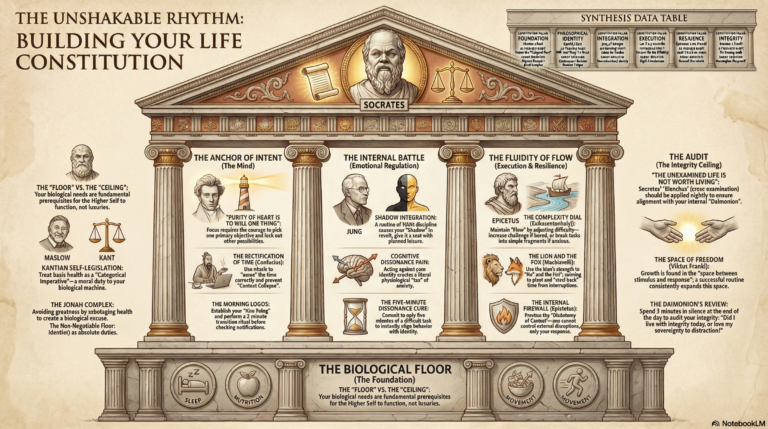
The Biological Floor: Self-Legislation of the Animal
Before the soul can flourish, before the mind can contemplate the sublime, and before the professional can solve complex problems, the biological vessel must be stabilized. We often view self-care as a luxury, a treat for the weekend, or a reward for “earning” rest. However, ancient and modern wisdom suggests it is the fundamental prerequisite—the absolute “floor”—for any meaningful action. Without this foundation, the “Higher Self” is merely a ghost haunting a crumbling machine. If the body is in crisis, the spirit is effectively grounded.
The Hierarchy of Needs and the Jonah Complex (Abraham Maslow)
Abraham Maslow’s hierarchy is often misunderstood as a static ladder one climbs once and for all. In reality, it is a dynamic foundation that requires daily maintenance. We cannot reach Self-Actualization—the peak of our creative, intellectual, and moral potential—if the bottom rungs of sleep, safety, and nutrition are rotting. Maslow also identified a peculiar psychological phenomenon known as the “Jonah Complex”: our subconscious tendency to fear our own greatness and run away from our destiny.
We often use “pathological busyness” and environmental chaos as defense mechanisms to avoid the terrifying responsibility of our own talents. By neglecting our basic health, we effectively sabotage our ability to ever reach the top, giving ourselves a convenient, biological excuse for a life of unfulfilled potential. We hide in exhaustion because the alternative—confronting our true power—is far more demanding. To maintain the floor is to remove the excuses of the ego.
The Categorical Imperative & Autonomy (Immanuel Kant)
Immanuel Kant proposed the Categorical Imperative: act only according to that maxim whereby you can, at the same time, will that it should become a universal law. In the context of a personal routine, this means treating your basic health as a “Self-Legislation.” You are the sovereign of your own life, and a sovereign must be a just legislator.
You do not sleep eight hours or move your body because you “feel” like it; you do it because it is a moral duty to the biological machine that houses your consciousness. Kant distinguished between Autonomy (following a law you gave yourself) and Heteronomy (being pushed around by external desires, appetites, and algorithmic impulses). A routine is your formal declaration of autonomy—a refusal to be a passenger in your own skin. When you follow your own constitution, you are finally free, for true freedom is not the absence of rules, but the presence of self-chosen discipline.
Essence of Wisdom Tip: The Non-Negotiable Floor. Identify your three “biological minimums” (e.g., 7 hours sleep, 20 mins movement, 1L water). Treat these as Kantian duties rather than options. If the floor is missing, the ceiling of your potential will naturally lower. When the storm of life hits, you may drop other tasks, but you never drop the floor. To do so is to surrender your sovereignty to entropy.
The Anchor of Intent: Establishing the Sovereign Day
Once the animal is stabilized, the mind must be anchored. Without a “Logos”—a central, organizing meaning—the day becomes a series of accidental movements, frantic reactions, and what the Greeks called akrasia (acting against one’s better judgment).
Purity of Heart and the Leap of Faith (Søren Kierkegaard)
Kierkegaard asserted that “Purity of heart is to will one thing.” Most routines fail because they suffer from “Optimization Overload”—the frantic attempt to be a perfect parent, a world-class athlete, a visionary entrepreneur, and a mindful sage all before 9:00 AM. This scattered intent leaves the soul paralyzed and exhausted.
Establishing a routine requires a Leap of Faith: the courage to pick one primary objective for the day and commit to it fully, despite the “dread” of the infinite possibilities you are intentionally leaving behind. This is the act of turning the anxiety of choice into the power of singular focus. When we try to keep every door open, we remain stuck in the hallway; the unshakable rhythm begins when we choose which room we will inhabit for the day and lock the door against the noise of the world.
Li and the Rectification of Time (Confucius)
Confucius emphasized Li (Ritual Propriety) and Zhengming (The Rectification of Names). He argued that social and personal order begins when we call things by their true names. In our digital lives, we suffer from “Context Collapse,” where the boundaries between professional, domestic, and private spheres dissolve. If you label an hour on your calendar “Deep Work” but spend it checking emails, Slack, and news headlines, you have “misnamed” the time.
This linguistic dishonesty leads to a breakdown in your internal governance; your brain no longer trusts your commands. Use rituals—small, sacred signals—to rectify the transition from rest to purpose. A specific way of opening your laptop, a particular tea, or a moment of silence can act as a bridge between your domestic self and your creative self. Ritual is the neurochemical grammar of the soul; it provides structure to the poetry of our work, transforming the mundane into the meaningful.
Essence of Wisdom Tip: The Morning Logos. Identify your “One Thing” before checking a single notification. Perform a 2-minute ritual (a specific breath, tea, or posture) to “rectify” the time before beginning your primary task. By naming the time correctly, you command your neurochemistry to align with your intent, creating a “Sacred Space” within a profane world.
The Internal Battle: The Alchemy of Friction
Procrastination is rarely a time-management problem; it is an emotional regulation failure. It is the friction between the person we are in the moment—vulnerable, tired, or afraid—and the idealized version of the person we feel we “should” be.
Shadow Integration and the Persona (Carl Jung)
The Persona is the mask we wear for the world—the “Productive Professional,” the “Perfect Student,” or the “Stoic Leader.” The Shadow is the part of us that is tired, resentful, bored, and wants to escape responsibility. If your routine is 100% Persona—all discipline, no delight, and all “shoulds”—your Shadow will eventually revolt.
This revolt manifests as “Self-Sabotage”: a sudden, uncontrollable urge to procrastinate, often on the most vital tasks. A life constitution must integrate the Shadow, providing it with “safe chaos” and planned leisure so it doesn’t burn down your house of order in a fit of repressed rage. A routine that ignores the Shadow is not a plan; it is a ticking time bomb. Integration means admitting that the “lazy” part of you needs a place at the table so it doesn’t steal the entire meal.
Cognitive Dissonance (Leon Festinger)
When we believe ourselves to be disciplined, high-achieving individuals but act with sloth or distraction, we experience Dissonance Pain. This is a literal physiological sensation of anxiety and tension, a grating discord in the mind. We often scroll social media or engage in “productive procrastination” (cleaning the house instead of writing the report) not because we are interested in the distraction, but as a way to “numb” the pain of the dissonance between our stated goals and our current behavior.
Dissonance Pain acts as a cognitive tax. Every hour spent in this state of contradiction drains the mental energy you intended to use for the task itself. Recognizing this tax is the first step in reclaiming your focus; the longer you wait to start, the more “expensive” the task becomes in terms of metabolic and emotional energy. The “cost” of the task rises every minute you avoid it.
Divertissement and the Escape from Self (Blaise Pascal)
Pascal famously noted that “all of humanity’s problems stem from man’s inability to sit quietly in a room alone.” He called our frantic escape from this silence Divertissement (diversion). In the modern world, this manifests as a “phantom itch” to check a notification the moment a task gets difficult or the silence becomes loud.
A chaotic, over-busy routine is often a subconscious choice to avoid the terrifying clarity that comes with silence. We hide in our “to-do” lists and “urgent” emails so we never have to face the existential question: Is the life I am building actually worth living? True order requires the courage to dismantle the diversions and stand face-to-face with your own purpose, even when that purpose is currently unclear. Silence is the mirror of the soul; most of us keep it covered with noise.
Essence of Wisdom Tip: The Five-Minute Dissonance Cure. When you feel the “itch” to procrastinate, recognize it as Festinger’s Dissonance. Commit to just five minutes of the task. This small act aligns your behavior with your identity and instantly dissolves the psychological pain. It is the alchemy of turning “Friction” into “Forward Motion” by lowering the barrier to entry until the Shadow no longer feels threatened by the scope of the work.
The Fluidity of Flow: Dynamic Resolution
A constitution must be rigid in principle, but the execution must be as fluid as water. Nature does not follow a spreadsheet; it follows a rhythm of expansion and contraction, of effort and ease. A life that is too rigid becomes brittle and eventually shatters under the weight of reality.
Flow State and the Complexity Dial (Mihaly Csikszentmihalyi)
Flow—the state of optimal experience where time disappears—occurs in the narrow channel between anxiety (when the task is too hard for your current energy) and boredom (when the task is too easy). An unshakable rhythm requires constant “Biofeedback.” You must learn to read your internal signals and adjust the difficulty of your work in real-time.
This is what Csikszentmihalyi called the “Autotelic” experience—the ability to find the reward in the activity itself. If you are exhausted, don’t quit; lower the complexity dial. If you are bored, increase the challenge—perhaps by setting a tighter deadline or a higher quality standard—to keep your mind from wandering. Flow is not a static state you achieve; it is a balance you maintain, much like a pilot constantly adjusting the flaps on a wing to stay aloft in turbulent air.
Wu Wei and the Uncarved Block (Lao Tzu)
Wu Wei is the art of effortless action—of non-forcing and sailing with the wind rather than rowing against it. Pu is the “Uncarved Block” of simplicity, representing potential before it is marred by over-thinking or artificial complexity. A routine should not be a violent struggle against reality, but a way to flow with it.
If a project is blocked by external factors, don’t bang your head against the wall in a fit of “rigid discipline.” Instead, move to the next available objective with the simplicity of the uncarved block. The water does not stop when it hits a rock; it simply finds the next opening. This is the “Theology of Emptiness”—creating space in your day for things to happen naturally rather than forcing them into a pre-conceived, artificial box. Emptiness is not lack; it is availability.
The Doctrine of the Mean (Aristotle)
Aristotle taught that virtue is the “Golden Mean” between two vices: deficiency and excess. A routine should be neither a “deficiency of order” (leading to the anxiety of chaos) nor an “excess of rigidity” (leading to the brittle sterility of a machine). It is a Dynamic Equilibrium that allows for Eudaimonia (Flourishing).
True order is flexible enough to accommodate the “Black Swan” events of life—the sudden sickness, the emergency meeting, the unexpected opportunity—without causing the entire psychological structure to collapse. Flourishing happens in the middle ground, where structure provides support but not suffocating constraint, allowing the individual to be both disciplined and deeply human.
Essence of Wisdom Tip: The Complexity Dial. Use Csikszentmihalyi’s biofeedback to adjust your day in real-time. If you feel bored, increase the difficulty of the task by adding a constraint (e.g., a timer or a higher quality standard); if you feel anxious, break it into smaller, “stupidly simple” fragments. Flow is found in the constant adjustment of the sails, not the static position of the rudder.
The Strategic Fortress: Boundary Stewardship
External forces—emergencies, interruptions, and the demands of others—will inevitably attempt to breach your rhythm. You must be a steward of your own boundaries, protecting your focus like a king protects a citadel. This is not about being anti-social; it is about being pro-intent.
Strategic Efficacy: The Lion and the Fox (Niccolò Machiavelli)
To protect your rhythm in a world of conflicting interests, you must be both the Lion and the Fox. You need the strength and directness of the Lion to ruthlessly say “No” to the unnecessary, to close the door, and to protect your “Anchor” time from intruders. But you also need the craftiness of the Fox to pivot when a schedule is inevitably hijacked.
The Fox knows that if a meeting takes your morning, you do not abandon the day in frustration; you cleverly steal back your morning in the evening or transform a long commute into an ‘office of opportunity.’ Strategic efficacy is the refusal to let an external shift become an internal defeat. It is the wisdom to know when to fight for your time and when to adapt your methods. The Lion protects the border; the Fox navigates the terrain.
Prohairesis and the Internal Firewall (Epictetus)
The Dichotomy of Control states that we must accept externals while mastering our internal Prohairesis (Moral Choice or Volition). If the world breaks your plan, your routine isn’t “broken”—the context of your day has simply changed. Your new “routine” task is to respond to that interruption with Stoic composure.
Your “Internal Firewall” is your ability to choose your attitude regardless of the wreckage of your schedule. You are not responsible for the interruption—be it a traffic jam or a server crash—but you are 100% responsible for your reaction to it. Every obstacle is an opportunity to practice the principles of your constitution. The interruption is not an impediment to the work; it is the work.
Sympatheia and the Inner Citadel (Marcus Aurelius)
We are part of a larger social whole (Sympatheia). An unshakable routine isn’t a selfish act of isolation; it is what allows you to be a stable “Inner Citadel” for your family, your team, and your community. When everyone else is panicking, your order becomes their anchor.
By being ordered yourself, you become a point of stillness for those around you who are still caught in the storm. You do not organize your life so you can hide from the world, but so you can serve it with a clear mind and a full battery. Order is the prerequisite for effective compassion; you cannot pour from an empty or broken cup. To be a “Man for Others,” you must first be a “Man of Himself.”
Essence of Wisdom Tip: The Fox’s Pivot. When an external interruption occurs, do not abandon the day to nihilism. Apply Machiavellian cunning: move your “Anchor” task to a different time slot or reduce its scope to a “Minimum Viable Product.” Being a “Fox” allows you to protect your “Lion” goals while staying adaptable to the needs of the social body. Resilience is the ability to maintain the “What” while being endlessly flexible with the “When.”
The Audit: The Laboratory of the Soul
The examined day is the only one worth repeating. Without reflection, we are simply walking in circles in the dark, repeating the same entropic errors forever. The audit is where the raw data of your day is transformed into the wisdom of your life. It is the process of extracting gold from the leaden hours of work.
The Space of Freedom (Viktor Frankl)
Viktor Frankl taught that our ultimate freedom lies in the “space between stimulus and response.” In that space lies our growth and our happiness. At the end of the day, review that space. Did you merely react to the stressors of the day with animalistic impulse, or did you find the “Pause” necessary to choose a meaningful response?
A successful routine is one that consistently expands this space over time, turning high-pressure moments into opportunities for wisdom rather than sources of regret. The goal is to make the “space” so wide that you are never truly a victim of circumstance. If the space exists, you are free; if it doesn’t, you are a machine.
The Socratic Elenchus and the Daimonion (Socrates)
The Socratic Elenchus is a cross-examination of the soul. At night, perform a “Daily Audit” of your actions. Listen to your Daimonion (your inner warning voice or conscience). If you were busy but lacked integrity, or if you were productive but unkind to those around you, the Daimonion will tell you through a sense of internal unease.
To ignore this voice is to ensure that tomorrow’s routine will be as hollow as today’s. The audit is where the “Constitution” is amended, improved, and tightened. It is where we ensure the life we are practicing is a life we actually want to own when the final curtain falls. The unexamined day is a waste of a life; the examined day is a step toward the divine.
Essence of Wisdom Tip: The Daimonion’s Review. Spend 5 minutes in Pascalian silence at the end of every day. Perform a Socratic audit: “Did I live with integrity today? Where did I lose my sovereignty to a distraction? How did I handle the ‘space’ between stimulus and response?” Listen to your inner voice. If it feels uneasy, adjust the “Constitution” for tomorrow. This is how you turn a single day into a deliberate step toward wisdom.
The Life Constitution: Synthesis Chart
| Constitution Pillar | Philosophical Guardian | Actionable Habit | Common Enemy Defeated |
| Foundation | Maslow / Kant | Protect the “Biological Floor” (Sleep/Movement). | Physical Burnout / The “Jonah Complex” |
| Identity | Kierkegaard / Confucius | Will “One Thing”; use Ritual (Li) to anchor. | Aimlessness / Decision Fatigue |
| Integration | Jung / Festinger | Admit the Shadow; start to end Dissonance. | Procrastination / Anxiety |
| Execution | Lao Tzu / Aristotle | Practice Wu Wei; find the Golden Mean. | Rigid Perfectionism / Brittle Systems |
| Resilience | Epictetus / Machiavelli | Apply Fox & Lion tactics to external chaos. | External Overwhelm / “Victim” Mindset |
| Integrity | Socrates / Pascal / Frankl | The Evening Audit; embrace the Silence. | Meaningless “Busywork” / Moral Decay |
Essence of Wisdom: Tactical Tips Summary
| Tip Name | Philosophical Strategy | Key Outcome |
| The Non-Negotiable Floor | Kant’s Duty | Stabilizes the biological vessel to prevent systemic collapse. |
| The Morning Logos | Confucius’ Li | Rectifies the time and anchors the day’s purpose before the noise. |
| The Five-Minute Cure | Festinger’s Dissonance | Dissolves procrastination by aligning action with identity. |
| The Complexity Dial | Csikszentmihalyi’s Flow | Keeps the mind in the high-engagement channel through adjustment. |
| The Fox’s Pivot | Machiavelli’s Strategy | Preserves the “Anchor” despite inevitable external interruptions. |
| The Daimonion’s Review | Socrates’ Elenchus | Ensures the examined life through honest, nightly reflection. |
Conclusion: The Sovereignty of Intent
When we weave these 15 philosophical threads into a single garment, the overarching theme is the Sovereignty of Intent. An unshakable rhythm is not a clock to be followed with robotic precision; it is a Constitution to be lived with human dignity. It is the profound realization that while we cannot control the vast, cold, and often indifferent machinations of the universe, we are the absolute architects of the immediate context that shapes our consciousness.
By being rigid in your principles (your “Constitutional Base”) but fluid in your tactics (your “Dynamic Execution”), you move from “reacting” to the compounding storm to becoming the “Inner Citadel” that remains standing through it. You move from the frustration of being “busy” to the tranquility of being Ordered. Order is not a destination, but a way of traveling. You do not need more hours in your day; you need a more profound context for the hours you already have. Start today: rectify one name, will one thing, and protect your floor. Your constitution is the only thing standing between you and the storm of entropy.
References & Further Reading
- Aristotle. Nicomachean Ethics. (The Golden Mean and Eudaimonia).
- Aurelius, M. Meditations. (Sympatheia and the Inner Citadel).
- Confucius. The Analects. (Li and the Rectification of Names).
- Csikszentmihalyi, M. Flow: The Psychology of Optimal Experience. (Biofeedback and the Skill-Challenge ratio).
- Epictetus. The Enchiridion. (The Dichotomy of Control and Prohairesis).
- Festinger, L. A Theory of Cognitive Dissonance. (Resolution of psychological tension).
- Frankl, V. Man’s Search for Meaning. (The Space between Stimulus and Response).
- Jung, C. Modern Man in Search of a Soul. (Shadow Work and Individuation).
- Kant, I. Groundwork of the Metaphysics of Morals. (The Categorical Imperative).
- Kierkegaard, S. Purity of Heart is to Will One Thing. (Singular Intent and the Leap of Faith).
- Lao Tzu. Tao Te Ching. (Wu Wei and the Uncarved Block).
- Machiavelli, N. The Prince. (Strategic Efficacy: The Lion and the Fox).
- Maslow, A. Toward a Psychology of Being. (The Hierarchy of Needs and the Jonah Complex).
- Pascal, B. Pensées. (Divertissement and the Infinite Silence).
- Plato. The Apology of Socrates. (The Elenchus and the Daimonion).