By: Jude Chartier
Let us begin by acknowledging the harrowing reality we all face: we are living through a “crisis of connection.” In our modern, hyper-linked world, we are more “connected” than any generation in human history, yet we find ourselves increasingly fragmented, transactional, and emotionally exhausted. This is the hallmark of the Compounding Storm—a state where digital noise, professional pressure, and the collapse of traditional social boundaries have created a phenomenon known as Context Collapse. We find ourselves “networking” rather than truly connecting; we “manage” our partners as if they were milestones in a project; and we treat our friends as commodities to be traded in a social marketplace.
In this state of collapse, your phone is a portal where a work email from your boss sits inches away from a heartfelt text from your mother and a toxic comment from a stranger. Your brain, evolved for tribal intimacy and singular contexts, cannot handle this collision of worlds. It creates a state of “Social Static” where the signals of love are drowned out by the noise of obligation. You are not just tired; your soul is being fragmented by competing demands. To flourish, you must stop being a reactive passenger in this entropic social web. You must become an intentional designer. This requires a Relational Architecture—a blueprint for human connection that is rigid in its core principles but fluid in its daily execution. We will start by looking at the ancient sages to build our metaphysical foundation, and then we will look to modern psychology to understand the internal mechanics of the heart.
Part I: The Ancient Blueprint
To build a lasting structure, we must first look at the duties we owe to one another. Ancient philosophy teaches us that relationships are not merely about “feelings,” which are as fleeting as the weather; they are about the roles we play and the honor we maintain within those roles. If you build a house on the shifting sands of “mood,” it will fall. You must build on the bedrock of character.
Confucius, the great architect of social order, argued that the primary cause of chaos is Zhengming, or the “misnaming” of things. When a father does not act like a father, or a friend does not act like a friend, the very structure of the community begins to dissolve. He proposed Xiao (Filial Piety) and Li (Ritual Propriety) as the necessary cure for this entropy. Understand that rituals are not “empty” ceremonies; they are the neurochemical “glue” of mutual respect. They signal to the subconscious that the “Context” has changed. When you are sitting at the dinner table with your family but your mind is occupied by work emails, you are committing a naming error. You are physically present as a “Partner” or “Parent,” but mentally you are an “Employee.” This confusion of roles creates deep-seated resentment because it signals to your loved ones that they are a secondary priority, a mere background to your “real” life. By failing to rectify your name in that moment, you are effectively absent from the life you claim to cherish. You are a ghost at your own table.
Essence of Wisdom Tip: The Role Sanctuary. Clearly define your social roles through physical and digital boundaries. Create “Phone-Free Sanctuaries” in your home where your role is rectified. When you cross that threshold, you must mentally shed the professional mask and inhabit the name you carry in that space—be it spouse, parent, or friend. Presence is the highest form of respect; to be elsewhere while standing in front of someone is a form of relational theft.
Lao Tzu, the sage of the Tao, offers us a different perspective: the art of non-forcing, or Wu Wei. He observed that most of our relational conflict arises from a desperate, ego-driven desire to “carve” others into the image we have designed for them. We treat people like blocks of wood that need our “optimization,” or like clay that must be molded to fit our convenience. He used the metaphor of Pu, the “Uncarved Block,” to remind us that every human being has an inherent, natural state that must be respected if the bond is to survive. We often try to “fix” those we love because their perceived flaws make us feel uncomfortable, anxious, or out of control. We want to “standardize” them to reduce the friction in our own lives. Lao Tzu suggests that the most useful part of a relationship is actually the “void”—the space you leave for the other person to exist, breathe, and grow without your constant interference, “helpful” corrections, or subtle manipulations. Like a vessel, the value of a relationship lies in its emptiness—its capacity to hold the other person as they are, not as you wish them to be.
Essence of Wisdom Tip: The Art of Non-Forcing. Practice Active Observation rather than active correction. For one week, consciously stop giving “unsolicited advice” or attempting to optimize your partner’s habits. Observe their natural flow with curiosity rather than judgment. You will find that when the pressure of being “carved” is removed, the other person often finds the psychological space and internal motivation they need to grow on their own terms. Acceptance is the soil in which change actually grows.
Aristotle, in his study of human flourishing, identified three distinct types of friendship: Utility, Pleasure, and Virtue. He argued that while the first two are necessary for a functioning society, only the Friendship of Virtue leads to true Eudaimonia. A Friendship of Virtue acts as a “Mirror of the Soul.” You love the other person because you see the “Good” in them, and their very existence challenges you to refine your own character. Much of the exhaustion you feel in your social life comes from maintaining too many “Friendships of Utility”—transactional bonds where you are liked for what you do rather than who you are. These bonds are inherently fragile because they vanish the moment the utility disappears. Digital social media has amplified this, turning our entire social circle into a “Friendship of Utility” for the sake of social proof and algorithm engagement. We become “Social Resumes” rather than souls, and this transactionality leaves us hollow.
Essence of Wisdom Tip: The Virtue Filter. Perform a rigorous audit of your social circle. Identify the 3-5 people who actually challenge your character and call you to your higher self, even when it’s uncomfortable. Prioritize these “Friendships of Virtue” above all else. It is infinitely better to have three virtuous anchors than three thousand casual acquaintances who only know your “Persona.” If your circle doesn’t make you better, it is likely making you worse through psychological osmosis.
Epictetus, who understood the nature of freedom more deeply than perhaps any other thinker, focused on Prohairesis, or moral choice. He taught that we have no control over how others treat us; we only have control over our internal reaction. Relational chaos is frequently nothing more than a series of “reactionary feedback loops.” Your partner is moody, so you become defensive, which in turn makes them more aggressive. This is an “Amygdala Hijack” disguised as a conversation. Epictetus demands that you build an Internal Firewall. To allow yourself to be upset by another person’s behavior is to effectively hand them the keys to your internal citadel. You are making your peace of mind dependent on their permission, which is a form of spiritual slavery. You become a puppet whose strings are pulled by the whims of others.
Essence of Wisdom Tip: The Reaction Firewall. When you encounter unkindness, coldness, or moodiness, immediately tell yourself: “This behavior is an external event; my reaction is my sovereign choice.” Do not allow an “External” storm to breach your “Internal” tranquility. By refusing to react impulsively, you break the feedback loop and maintain your dignity. You are not a thermostat that fluctuates with the room’s temperature; you are a steady flame that provides its own heat.
Marcus Aurelius reminds us of Sympatheia—the profound idea that all human beings are limbs of the same social body. In the heat of an argument, we often find ourselves trying to “win” a point or “crush” an opponent. However, in the architecture of a relationship, if one person “wins,” the relationship as a whole “loses.” Because you and the other person are part of the same “body,” any harm you inflict through anger, sarcasm, or neglect is essentially a form of self-sabotage. What is bad for the hive is ultimately bad for the bee. We are designed for cooperation, yet we treat our homes like courtrooms where we act as both prosecutor and judge. This adversarial mindset is the primary source of relational entropy.
Essence of Wisdom Tip: Us vs. The Problem. Shift your linguistic framework from “Me vs. You” to a unified front. When a conflict arises, physically sit on the same side of a table as your partner. Remind yourself aloud that you are two limbs of the same body trying to heal a shared wound. The goal is resolution and healing, not victory and domination. If you “win” an argument at the cost of your partner’s dignity, you have both lost the only game that matters.
Socrates, our final ancient guide, believed that the “unexamined life” was not worth living. He used the Elenchus, or cross-examination, to strip away the false assumptions and lazy definitions that clutter our minds. Relationships often begin to decay in the silence of assumed knowledge. We think we know what our partner wants, feels, or thinks because we’ve been with them for years, so we stop asking. This is the “Illusion of Intimacy.” We become complacent, and complacency is the precursor to relational rot. Socrates also listened to his Daimonion—an inner voice of conscience—to ensure that his social actions never violated his intellectual or moral integrity. He was willing to be social, but never at the expense of his truth.
Essence of Wisdom Tip: The Socratic Inquiry. Practice Radical Inquiry to prevent relational stagnation. Once a week, ask your partner a deep, open-ended question like: “What is one thing I am currently assuming about you that is actually wrong?” or “What part of your life do I know the least about right now?” Replace the comfort of “Knowing” with the vitality of “Inquiring.” To love someone is to remain curious about them forever; the moment you think you “know” them completely, the relationship has become a museum rather than a living garden.
Part II: The Modern Mechanism
If the ancients provide the blueprint, modern psychology and ethics provide the mechanical gears that allow the bond to function in a complex, fast-moving, and often depersonalized world.
Immanuel Kant’s “Formula of Humanity” gives us a strict ethical boundary: treat people always as an end in themselves, never merely as a means to an end. This is a direct strike against the modern commodification of people. We are all guilty of “Objectification”—using people as emotional crutches to fill our voids, status symbols to bolster our egos, or simple distractions from our own boredom. Kantian ethics demands that we recognize the Autonomy of the other. Your partner or friend has a life, a purpose, and a sovereignty that exists entirely separate from your needs or desires. They are not a supporting character in your movie; they are the lead in their own. When we treat people as “Means,” we strip them of their dignity and turn our social lives into a series of cold calculations.
Essence of Wisdom Tip: The Intent Check. Before you ask for a favor, seek out someone’s company, or even start a casual conversation, perform a quick internal audit. Ask yourself: “Am I truly seeing this person’s essence right now, or am I just using them as a tool to solve my current problem or fill my current silence?” Treat their time and their will as sacred as your own. True love is the radical honoring of another’s autonomy.
In our age of dating apps and “infinite options,” Søren Kierkegaard warns us of the “Dread of Choice.” We often stay shallow in our connections because we are terrified that committing to one person means missing out on a hypothetical “better” version around the corner. This is the “Aesthetic Stage” of life—chasing novelty and dopamine rather than depth and meaning. Kierkegaard argues that without a Leap of Faith into deep commitment, we remain trapped in “aesthetic despair”—a hollow cycle of fleeting novelties that never actually nourish the soul. Meaning is found in the “Decisive Act” of choosing, not in the “Passive Act” of window shopping. This vertigo of freedom can only be cured by the grounding of devotion.
Essence of Wisdom Tip: The Commitment Anchor. Choose depth over breadth. Pick one primary relationship in your life—be it a spouse, a child, or a best friend—and decide that for a set period, you will not look for an “upgrade.” Depth of connection is only possible when the “exit doors” are firmly closed. Intimacy is a reward for the brave who stay, not the restless who wander. Commitment is the only thing that gives the “Leap” its power.
Niccolò Machiavelli, the pragmatist, spoke of the Lion and the Fox. In our social world, “Virtue” without “Efficacy” is often steamrolled by the noise of others. To protect the “Inner Citadel” of your private life, you must be a Lion in your strength and a Fox in your cunning. You must have the strength of the Lion to ruthlessly protect your boundaries—such as non-negotiable family time or silent hours—and the cunning of the Fox to navigate the social and professional politics that constantly try to interfere with those bonds. This is about “Boundary Stewardship”—the realization that your time is a finite resource that must be defended with strategic intent. If you do not protect your center, the world will insatiably devour it.
Essence of Wisdom Tip: Strategic Boundary Setting. Be a Lion about your “Sacred Hours.” If Friday night is for your partner, that time is a non-negotiable territory that no email or “urgent” request can breach. Use the craftiness of the Fox to manage your professional reputation and navigate social cues so that your “Lion-like” boundaries are respected rather than resented. You are protecting the peace of those you love from the noise of the world.
Blaise Pascal famously noted that we seek the company of others primarily to avoid the “Infinite Silence” of our own company. He called this Divertissement, or diversion. If you cannot bear to be alone, you are not truly “relating” to others; you are merely “using” them as an emotional anchor to keep from drifting into the depths of your own mind. This is the root of Co-dependency. If you are running from yourself, you will inevitably cling to others in a way that suffocates them. Your relationships become a series of escapes rather than a series of connections. A person who fears their own silence will always be a burden to their partner.
Essence of Wisdom Tip: The Solitude Prerequisite. You cannot have a healthy relationship with another until you can be alone in a room for thirty minutes without a phone or a distraction. Practice solitude as a form of “Relational Training.” When you are at peace with yourself, your connection to others moves from a place of “Desperation” to a place of “Choice.” A whole person loves differently than a broken person seeking a patch for their own emptiness.
Abraham Maslow placed “Belongingness” as a fundamental physiological need, but we often confuse “Attention” with “Belonging.” We seek thousands of followers on social media but have zero people we can call at three in the morning when the world falls apart. This creates a biological stress response—a “Loneliness Epidemic”—because your brain knows that a “Simulated” community provides no actual safety in a crisis. We are biologically wired for a small, tight “Inner Circle,” not a vast, shallow network. In a hectic life, we often sacrifice the “Circle” for the “Network,” leaving us socially famous but emotionally starved.
Essence of Wisdom Tip: The Inner Circle Audit. Focus your primary emotional energy on your 3–5 “Inner Circle” people. These are the individuals essential to your psychological safety and your sense of identity. Prioritize their needs and your deep connection to them over the superficial “noise” of your strategic social periphery. If your Inner Circle is weak, no amount of external “likes” will save your spirit when the storm arrives.
Carl Jung believed that we often project our Shadow—the parts of ourselves we refuse to acknowledge, our fears, our insecurities, and our hidden anger—onto our partners. When someone “irritates” you intensely with their behavior, it is frequently a mirror of a trait you haven’t integrated in yourself. This is “Shadow Projection.” We don’t see the person; we see our own darkness reflected back at us, and we attack them for it as a way to avoid looking in the mirror. Most relationship arguments are actually “Shadow Boxing” matches where the opponent is actually a phantom of our own making. We blame the other for the discomfort we feel within ourselves.
Essence of Wisdom Tip: The Projection Pause. When a loved one triggers a strong, disproportionate negative reaction in you, pause before you speak. Ask: “What part of my own Shadow is this person reflecting back to me right now? Am I angry at them, or am I angry at the part of me they represent?” This turns a potential argument into a profound opportunity for self-discovery and empathy. Integrating your Shadow is the fastest way to stop sabotaging your bonds.
Leon Festinger’s theory of Cognitive Dissonance explains the root of chronic resentment. We often hold an “idealized version” of a person in our heads—a script we want them to follow. When their actual behavior doesn’t match that script, we experience psychological pain (dissonance). Our instinct is to “edit” the person through nagging, criticism, or manipulation to fit our script, rather than changing our script to fit reality. This is a “Cognitive Tax” we pay on our happiness. We suffer because we refuse to accept the truth of the other person. We are in love with a fantasy, and we punish the reality for failing to live up to it.
Essence of Wisdom Tip: The Expectation Reset. When you feel disappointed or resentful, ask yourself: “Am I actually mad at this person’s actions, or am I mad that they aren’t following the fictional script I wrote for them in my head?” Accept the “Actual” person to dissolve the Dissonance. Forgiveness is often just the act of giving up your imaginary script and letting the other person be real. Order comes from accepting what is, not mourning what isn’t.
Mihaly Csikszentmihalyi discovered that the deepest bonds are forged in Shared Flow—activities where two people lose track of time and ego together. Passive bonding, like watching television together, is low-quality because it requires no mutual engagement, skill, or shared challenge. Active “Shared Flow” creates Neurochemical Synchrony, literally wiring two brains together through shared mastery. It moves the relationship from “Face-to-Face” (focused on each other’s flaws) to “Side-by-Side” (focused on a shared goal). When we lose ourselves in a task together, we find each other in a deeper way. Struggle together is the most potent relational glue.
Essence of Wisdom Tip: The Flow Date. Replace passive “low-effort” dates with shared challenges. Take a dance class, hike a difficult trail, learn a new language, or build a piece of furniture together. Shared Flow builds an unshakable bond because it creates a shared history of overcoming obstacles and experiencing mutual growth. Shared mastery creates a language that only the two of you speak.
Finally, Viktor Frankl found that meaning is often discovered in the “Space” we hold for another’s suffering. Love is the choice to see the other’s potential even when they are at their worst, their most vulnerable, or their most unlovable. This is the “Will to Meaning” in a relational context. In a crisis, the most powerful thing you can do is not to “fix” the problem, but to hold the space for the other person to be heard and seen. Meaning is found not in the solving, but in the witnessing. Witnessing another person’s suffering without flinching is the ultimate act of relational integrity.
Essence of Wisdom Tip: The Space of Listening. When your partner is in pain, resist the immediate urge to offer a “fix” or an “optimization.” Simply listen and hold the space. Validating their suffering without trying to “manage” it is the highest act of Relational Order. It signals that you value them more than the convenience of a “solved” problem. Intimacy is the courage to stand in the dark with someone.
Part III: The Synthesis – The Relational Constitution
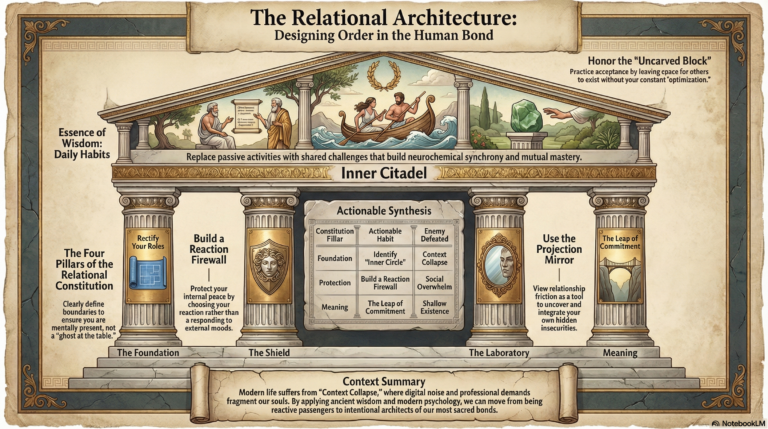
Students, the goal is to draw all fifteen of these disparate views together into a single, unified strategy. We must stop viewing relationships as “occurrences” that happen to us and start viewing them as an Architecture that we build with intent.
First, you must build the Foundation (Confucius & Maslow). This means stabilizing your “Biological Floor” by identifying who is truly in your Inner Circle and “Rectifying your Roles” so you are actually present when you are with them. Without this foundation, the structure of your life has no ground to stand on. You must know who your tribe is and show up for them with absolute integrity. You must stop the naming errors of Context Collapse. This foundation is the bedrock of safety that allows for all other growth.
Second, you must build the Shield (Epictetus & Machiavelli). You must protect the center of your life from external and internal storms. Use the Reaction Firewall to ensure your peace isn’t hijacked by others’ moods, and use the Lion and the Fox to guard your time and your energy from the insatiable demands of a chaotic, digital world. You must become a steward of your own boundaries. This shield is what preserves the sanctity of the “Inner Circle” against the entropic noise of the “Strategic Periphery.”
Third, you must use the relationship as a Laboratory of the Soul (Jung & Socrates). Do not run from conflict, friction, or the discomfort of self-discovery; use the Projection Mirror to find your own Shadow and Socratic Inquiry to keep the bond truthful, vibrant, and ever-evolving. Integrity is the light that prevents the rot of complacency. Every disagreement is not a threat, but a Socratic opportunity to reach a deeper truth about yourselves.
Finally, you must define the Meaning (Frankl & Kierkegaard). You must take the Leap of Commitment. Meaning is not found in the restless search for the “next best thing,” but in the “Space” you hold for the person you have chosen to walk with through the valley of the shadow. Loyalty is the ultimate defiance against the entropy of the modern world. It is the act of deciding that this particular human bond is a sacred end in itself, not a means to a fleeting feeling.
Relational Synthesis Chart
| Constitution Pillar | Actionable Habit | Enemy Defeated |
| Foundation | Identify “Inner Circle” & Rectify Roles. | Context Collapse & Role Confusion |
| Integrity | Practice Socratic Inquiry & Projection Mirror. | Unconscious Resentment & Stagnation |
| Protection | Build a Reaction Firewall; protect the “Inner Citadel.” | Social Overwhelm & Emotional Hijacking |
| Harmony | Seek “Shared Flow” & practice Wu Wei. | Relational Boredom & Coercive Control |
| Meaning | Take the “Leap of Commitment”; Hold space for suffering. | Shallow Existence & Aesthetic Despair |
Essence of Wisdom: Relational Tips Summary Chart
| Tip Name | Philosophical Strategy | Key Outcome |
| The Role Rectification | Confucius’ Li | Ensures presence and prevents “Employee Brain” from entering the home. |
| The Virtue Filter | Aristotle’s Mean | Purges transactional and toxic noise from your emotional battery. |
| The Projection Mirror | Jung’s Shadow | Transforms conflict into an opportunity for personal growth and empathy. |
| The Shared Flow Date | Csikszentmihalyi’s Flow | Forges deep, neurochemical bonds through shared challenge and mastery. |
| The Reaction Firewall | Epictetus’ Control | Prevents others’ moods from hijacking your internal peace and sovereignty. |
| The Socratic Inquiry | Socrates’ Elenchus | Replaces shallow assumptions with deep, truthful, and ongoing connection. |
Conclusion: The Sovereignty of Connection
An unshakable relationship is not a lucky accident of chemistry; it is a Constitution to be lived with relentless intent. By being rigid in your principles—your loyalty, your roles, and your duty—but fluid in your daily execution—your communication, your curiosity, and your forgiveness—you move from the frustration of being “social” to the tranquility of being Connected.
You do not need “more” friends, “better” partners, or a wider network; you need a more profound context for the people you choose to love. You must become the architect of your own peace. Start today: rectify one role, ask one Socratic question, and protect your center. The storm of the modern world is coming, but your architecture will stand.