In our journey thus far, we have built a fortress of the self. We established the Mountain—that unshakeable center of gravity that keeps us standing when the world turns to chaos. We fletched the Arrow—the vector of alignment that ensures our daily actions are stacked and pointed toward a singular, noble purpose. Then, we executed the Strike—the kinetic moment where our intent collided with the friction of reality, navigating power, manipulation, and resistance.
But now we reach the part of the story that most high-achievers, leaders, and seekers ignore until the structural cracks become impossible to hide. We reach the aftermath. We reach the “day after” the great battle, where the silence is louder than the shouting ever was. This is the period of the rubble, where the smoke of the “Strike” begins to clear, revealing the true cost of the collision.
Whether your arrow hit the bullseye or shattered against a stone wall, the result is the same: you are now standing in the debris. You are exhausted. The adrenaline of the “Strike” has faded, leaving behind a psychological “hangover” that can feel like a deep, pervasive emptiness. Your muscles are heavy, your mind is foggy, and your heart feels strangely hollow. This is the stage of Renewal.
If Centering is the foundation and Alignment is the aim, then Renewal is the Soil. It is the act of re-composting your experiences—the wins that puffed your ego, the losses that bruised your spirit, and the sheer fatigue of the journey—into the nutrients required for your next “Mountain.” Without the Soil, the Mountain eventually erodes into dust, and the Archer loses the mechanical strength to pull the bow. This is not a luxury or a reward for “working hard”; it is a biological and spiritual prerequisite for a life of unshakable stability.
I. The Two Faces of Renewal: Failure and Success
Renewal is often misunderstood as “taking a vacation” or “self-care.” In reality, it is a sophisticated cognitive and existential reset required for two very different, yet equally destabilizing, human experiences: Failing and Finishing. Both require a complete dismantling of the “Archer” identity to allow the human underneath to recover.
Scenario A: The Failed Strike (Burnout and the Narrative Break)
When you strike with all your might and the world resists you—when the business fails, the relationship ends, or the social cause you fought for collapses—you don’t just lose a goal; you lose a part of your identity. This creates a “Narrative Break.” The story you were telling yourself about who you are—the “successful entrepreneur,” the “indispensable partner,” or the “effective leader”—has been cut short.
This creates an intense “External Friction” that quickly turns inward. You aren’t just tired; you are existentially wounded. You begin to tell yourself that your “Center” was a lie and your “Arrow” was crooked from the start. This is the trauma of the missed strike. Renewal here is about healing the Allostatic Load—the cumulative wear and tear on your spirit—and proving to yourself that the Archer is a being of intrinsic value, entirely independent of the result of the shot. It is the process of picking up the shattered pieces of your arrow and realizing they can be used as kindling for a new fire, rather than evidence of your inadequacy.
Scenario B: The Finished Mission (Paradox of the Post-Success Void)
Strangely, landing the Arrow can be just as dangerous as missing. When a major mission is completed—the project is delivered, the degree is earned, or the promotion is secured—the “Alignment” that gave your life meaning for months or years suddenly vanishes. The target is gone, and with it, the tension of the bowstring that kept you feeling “alive.”
You wake up on Monday morning and the target you’ve been staring at is gone. This creates an existential vacuum. In a culture obsessed with “what’s next,” we often try to fill this void by immediately grabbing another arrow and firing blindly at any target we see just to feel that tension again. This leads to The Cortisol Trap—a state of chronic, aimless stress where you are running as fast as you can, but you are no longer aligned with anything. You are just addicted to the feeling of the “Strike.”
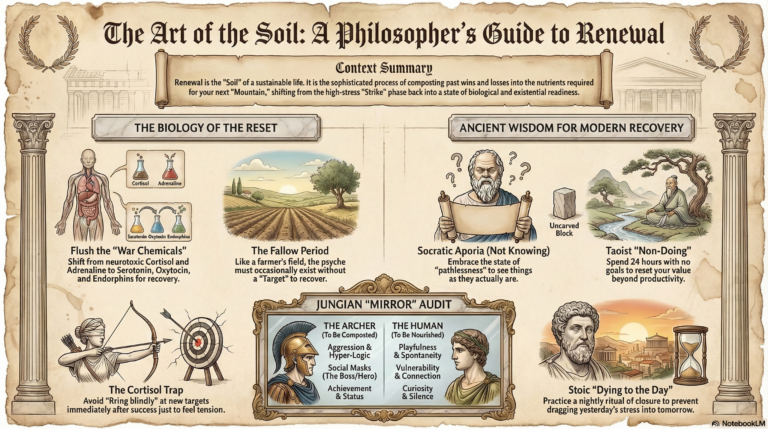
In both cases, the solution is the Fallow Period. Just as a farmer must let a field sit without a crop to regain its minerals and nitrogen, the human psyche must occasionally exist without a “Target” to regain its soul. Renewal is the period where we allow the “Debris” of the past—the old roles, the old goals, and the old stresses—to rot away so the “Soil” can become fertile again.
II. Biological Backdrop: Shifting the Internal Chemistry
We won’t get bogged down in lab reports, but we must acknowledge that your “Unshakable Center” is supported by a specific chemical environment. During the Strike, your body was effectively a war machine. You were flooded with Cortisol and Adrenaline—the survival chemicals. These are designed for short-term bursts of high-friction activity; they sharpen your focus, increase your heart rate, and suppress your immune system so you can hit the target.
However, when these chemicals stay in your system for months, they become neurotoxic. They physically shrink the Prefrontal Cortex—the seat of your logic, your “Observer,” and your “Alignment”—and they swell the Amygdala, making you hyper-reactive, anxious, and prone to panic. You become a “Mountain” made of glass—hard, but incredibly brittle.
Renewal is the biological process of flushing these “War Chemicals” out and replacing them with Serotonin (satisfaction), Oxytocin (connection), and Endorphins (recovery). This is not just “relaxing”; it is a physiological reallocation of resources. It is the act of telling your nervous system: “The threat has passed. The mission is over. We are no longer at war. It is safe to grow, to heal, and to rest.” Without this shift, you aren’t “pushing through”—you are literally burning your engine out of its mounting, sacrificing your long-term hardware for a short-term software update.
III. Socratic Reset: Intellectual Humility / Internal Veto
Socrates famously argued that “the unexamined life is not worth living,” but for the person standing in the debris of a mission, we must add: “The unexamined success is a prison.”
The Theory of Aporia: The Gift of Not Knowing
When a mission ends or a strike fails, Socrates would lead us into a state of Aporia—a Greek term for “intellectual puzzlement” or “pathlessness.” This is the moment you admit you don’t know what comes next. High-achievers hate this state; they want a plan, a roadmap, and a new target to attack.
But success often breeds a Double Ignorance—the belief that because we hit one target, we have life “figured out.” This makes us brittle and resistant to new information. Renewal requires a “Socratic Reset,” where we strip away our titles and certainties until we are back to the “Uncarved Block.” We must embrace the Aporia. If you don’t know what’s next, you are finally in a position to see things as they actually are, rather than through the lens of your previous mission. This “pathlessness” is the only space where a truly original path can be found.
The Daimonion’s Silence
Socrates often spoke of his Daimonion—an internal “voice” or gut feeling that only ever spoke to tell him “No.” It was his “Sacred Veto.” In the renewal phase, this voice is your greatest ally. When you feel a frantic, cortisol-fueled urge to start a new project, sign a new contract, or say “yes” to a new obligation just to avoid the discomfort of the “Void,” the Daimonion whispers: No. Not yet.
Renewal is the practice of listening to that veto. It is the courage to stay in the chair, to stay in the silence, and to wait until the new “Alignment” reveals itself with the clarity of a sunrise, rather than the franticness of a fire. It is the refusal to accept a “Good” target when the “Great” one hasn’t yet appeared.
Practical Exercise: The “Beginner’s Mind” Audit Find a quiet space with a notebook. List your three most “successful” habits, professional titles, or foundational beliefs that defined your last mission. For each one, ask: “If I were starting from zero today, with no history, no baggage, and no expectations, would I still choose this?” Force yourself to argue against your own success. This breaks the “cement” of your identity and turns it back into “soil,” allowing you to be a student once more.
IV. The Taoist Void: Returning to the Uncarved Block
Lao Tzu’s perspective on renewal is perhaps the most radical. He taught that “Returning to the root is peace.” In our first two episodes, we focused on the “Mountain” and the “Arrow”—the “Carved” and highly specialized versions of our lives. But Lao Tzu reminds us of Pu—the Uncarved Block.
The Philosophical Meaning of Non-Doing
Wu Wei (effortless action) is not just a tool for the Strike; it is the essence of the Soil. Renewal is the art of Yielding to the Winter. In the natural world, nothing blooms all year long. The tree that tries to grow leaves in January dies of exhaustion because it is fighting the Tao (the way of nature). Why do we expect our careers, our creativity, or our psyches to be different?
Taoist renewal is the process of shedding your “Social Masks”—the Boss, the Provider, the Hero, the Victim—and returning to your original, uncarved nature. It is the realization that you are valuable simply because you exist, not because of what you are currently hitting. When you return to the “Uncarved Block,” you regain your versatility. You are no longer just an “Arrow” meant for one target; you are the raw wood from which anything—a bridge, a house, a new bow—can be fashioned.
Practical Exercise: The “Taoist Void” Day Set aside 24 hours where you have absolutely no goals. Hide your phone, hide your watch, and remove any “To-Do” lists. You do not “exercise” to get fit; you walk because your body wants to move. You do not “read” to learn or “curate”; you look at pages because you are curious. You do not “network”; you talk to people because you like them. This “Non-Doing” signals to your brain that your value is not tied to your productivity. It is the most powerful “Reset” a modern, digital human can experience, effectively resetting the baseline of your nervous system and allowing the “Observer” to regain control.
V. The Aristotelian Mean: Recalibrating Excellence
Aristotle taught us the Doctrine of the Mean—the idea that virtue is the high point between two extremes. When we are in the “Strike” phase, the Mean is centered on Courage, Magnificence, and Ambitious Drive. But in the “Renewal” phase, the Mean shifts significantly.
The Phronesis of Recovery
What was once “Laziness” (the deficiency of action) may now be “Temperance” (the virtue of rest). Aristotle’s concept of Phronesis (Practical Wisdom) requires us to recognize what “Season” we are in. If you have just finished a three-year mission or survived a major failure, “pushing harder” is no longer Courage; it is Rashness (the excess of action).
Renewal is the habit of recalibrating your Bullseye. You are still aiming for excellence, but the excellence of this season is Restoration. To be an Aristotelian in the Soil phase is to realize that being “busy” when you are “broken” is a vice, not a virtue. It is the wisdom to know that a well-rested archer hits more targets than a frantic one. True excellence is knowing when to drop the bow and when to pick it up.
Implications of the Mean: When we fail to recalibrate, we fall into the “vices of exhaustion.” We become either Apathetic (giving up on the Archer entirely) or Obsessive (trying to Strike when we have no strength). Renewal is the “Golden Mean” of active recovery—doing exactly what is necessary to return to full strength, no more and no less.
VI. Jungian Afternoon: Individuation and the Mirror
Carl Jung had a profound theory about the “Morning” and “Afternoon” of life. The “Morning” (the first half of a project or a life) is about the Ego—building the Arrow, hitting the target, establishing your reputation, and finding your place in the social hierarchy. It is a necessary but “specialized” phase. But the “Afternoon” is about Individuation—becoming a “Whole” person rather than just a “Successful” one.
The Theory of Individuation: Moving Beyond the Persona
Jung observed that many people face a deep “mid-project crisis” or “post-success depression” because the Ego has finished its job, and it doesn’t know what to do next. The “Persona”—the mask you wore to achieve the “Strike”—doesn’t fit anymore. It feels heavy and suffocating.
Renewal is the process of Integrating the Shadow. You must look at all the parts of yourself you were forced to ignore or repress in order to hit that target. Perhaps you ignored your need for art, your suppressed emotions, your health, or your need for silence. Individuation is the act of bringing these “Shadow” elements into the light and giving them space to breathe. You stop being a “specialized tool” (The Archer) and start being a “Whole Human” (The Soil).
Practical Exercise: The “Post-Strike” Mirror Journal Divide a notebook page in two.
- On the left: List everything you gained from your last mission (money, status, skills, accolades).
- On the right: List everything you sacrificed to get it (sleep, spontaneity, family connection, peace, curiosity, hobby).
Your “Renewal Mission” for the next month is to spend your energy exclusively tending to the right-hand column. This is the act of “Individuation”—refusing to be a one-dimensional arrow and insisting on being a whole person. This integration ensures that your next Arrow is launched by a whole human, not a fragmented one.
VII. Stoic Fortitude in the Ebb: Dying to the Day
Stoicism is the armor of the soul. Marcus Aurelius and Epictetus knew that the world is not a straight line, but a series of “Ebbs and Flows.” Impact is the “Flow”; Renewal is the “Ebb.”
Amor Fati and the Compost of Failure
The Stoic practices Amor Fati (Love of Fate). If your strike failed, the Stoic doesn’t just “tolerate” the disappointment; they embrace it as the exact material needed for their next iteration. “The impediment to action advances action,” Aurelius wrote. The failure is not an obstacle to your path; it is the path. The failure is the “Debris” that, when properly composted through reflection, makes the most fertile soil for the next mission. It is the data that makes the next aim truer.
The Ritual of “Dying to the Day”
The most practical Stoic tool for renewal is the Nightly Audit, but taken to a metaphysical extreme. Aurelius believed we should go to bed every night as if our life has ended. When you close your eyes, the “Archer” of that day is dead. The mission is closed. The wins are gone; the losses are forgiven.
This prevents Psychological Carry-over—the tendency to drag the stress, guilt, or hubris of yesterday’s strike into today’s mountain. By “dying” every night, you wake up with a “Clean Slate.” You aren’t “recovering” from yesterday; you are a brand-new entity starting fresh with a full tank of energy. This is the ultimate preventative measure against burnout. It allows the Archer to wake up without the “Ghost” of the missed shot haunting their grip.
Practical Exercise: The Closure Ritual Before bed, physically wash your face and hands with the intention of “washing off” the day’s mission. Say to yourself: “I have lived. I have finished the course that fortune set for me.” (Aurelius actually used this phrase). Leave the “Arrow” in the quiver. Enter the “Inner Citadel” of the sleep state with zero attachments to your results. If you wake up, it is a bonus; if you don’t, you have already made your peace.
VIII. Existential Rebirth: Kierkegaard, Pascal, the Leap
This section is where we face the “Infinite Silence.” Blaise Pascal observed that humans are so terrified of the “Void” (the space where the Strike is over) that we engage in Divertissement (Divergence or Distraction). We doom-scroll, we start new hobbies we don’t like, we check emails that don’t matter, and we take on meaningless projects just to avoid being alone with our own thoughts.
Pascal’s Silence: The Courage of the Chair
Renewal requires the “Quiet Room.” It is the courage to sit with your own insignificance. When the “Strike” is over and the applause (or the criticism) stops, you are no longer the “Hero.” You are just a person in a chair. Pascal argued that only in this silence, when the noise of the world fades, can we find our true “Center.” The “Void” isn’t something to be filled with noise; it is the space where renewal happens. It is the “Fallow Field” of the soul.
Kierkegaard’s Leap of Faith: Beyond the Burning Cliff
Søren Kierkegaard spoke of the Leap of Faith. To understand this in the context of renewal, imagine you are standing on a cliff. Behind you, your old mission (your old “Arrow”) is on fire—either it’s finished or it’s failed. In front of you is a dark abyss of “What now?”
Most people are too terrified to leave the burning cliff, so they stay in a state of chronic burnout, trying to breathe the smoke of their past. They keep trying to “fix” the old arrow. The Leap is not a leap into a new specific goal; it is a Leap into Meaning. It is the decision to believe that even though you don’t have a “Target” right now, your life still has intrinsic value and purpose. It is the commitment to your own “Center” even when the “Alignment” is currently invisible. You leap into the “Soil,” trusting that the universe (or the Tao) will eventually provide the nutrients for a new “Mountain.” It is the ultimate act of trust in the “Infinite Cycle.”
IX. Ritual of the Soil: Confucius, Kant, and the Debris
Finally, we look at the physical Rectification of our environment. Confucius and Kant provide the “Outer” framework for the “Inner” reset. Renewal is not just a mental state; it is a physical order.
Confucius and the Rectification of Space
Confucius believed that internal order follows external ritual (Li). If you are in a state of burnout or the “Post-Success Void,” your environment is likely full of the “Debris of the Strike”—half-finished emails, messy desks, stacks of mail, and “reactive” clutter.
To renew, you must physically clear the debris. By ordering your room, your schedule, and your habits, you are signaling to your brain that the “Strike” phase is officially over. You are “Rectifying your Space” to match your new state as a “Neutral Observer.” This physical act of cleaning is a profound psychological signal that the past is gone and the soil is ready. You are clearing the runway for the next Mountain.
Kant’s Universal Law of the Reset
Immanuel Kant’s Universal Law asks: “If everyone on earth worked the way I am working right now—ignoring rest, chasing targets until they break—would the human race flourish or collapse?” If the answer is, “They would all burn out and die,” then your current refusal to rest is not a sign of “hustle”—it is a Moral Failure.
Kant argued that we have a duty to be sustainable. You are not a “tool” to be used up and thrown away by a corporation or your own ego; you are a “Member of the Kingdom of Ends.” Therefore, the “Reset” is not a luxury; it is a Categorical Imperative. You must rest because a world where no one rests is a world that eventually breaks into chaos. You have a moral obligation to be the “Soil” so that your next “Impact” is universalizable, sustainable, and “Good.”
X. Soil Protocol: Practical Frameworks for Renewal
To transition from the exhaustion of the Strike to the restoration of the Soil, one must move beyond theory. Below are five high-leverage frameworks for implementing renewal.
1. The Socratic “Aporia” Audit (Intellectual Reset)
The Goal: To dismantle the “Double Ignorance” of success or the paralysis of failure.
- Step 1: The Identity Strip-Down. List your three most prominent social titles (e.g., “Entrepreneur,” “Provider,” “Director”).
- Step 2: The Radical ‘Why’. For each title, ask yourself: “If this title were taken from me tomorrow by fate, what part of my ‘Mountain’ would still be standing?”
- Step 3: The Ignorance Acceptance. Identify one major belief you have about your future. Spend ten minutes writing a logical argument for why that belief might be entirely wrong.
- Outcome: This returns you to a state of wonder, which is the only soil where new, authentic “Arrows” can grow. It clears the “certainty” that leads to brittleness.
2. The Taoist “Pu” Day (Biological Reset)
The Goal: To shed the “Carved” roles and return to the “Uncarved Block” (Pu).
- Implementation: Choose one Saturday or Sunday every quarter.
- The Rules: * No Clocks: Hide your phone and watch. Eat when hungry, sleep when tired.
- No Targets: You are forbidden from doing anything for a “result.” If you walk, you must have no destination. If you cook, you must not worry if it’s “healthy” or “good.”
- The Veto: Every time your brain says, “I should be doing something productive,” use the Socratic Veto and simply breathe.
- Outcome: This clears the Allostatic Load and resets your baseline dopamine levels, allowing you to find joy in existence rather than achievement.
3. The Jungian “Second Half” Mirror (Psychological Reset)
The Goal: To integrate the Shadow and ensure you aren’t becoming a “one-dimensional tool.”
- Implementation: Perform this once your project or life-phase is 100% finished.
- The Exercise: Draw a line down a page.
- Column A (The Archer): List the skills you used to succeed (e.g., “Aggression,” “Hyper-Logic,” “Stoicism”).
- Column B (The Human): List the parts of you that “starved” while the Archer was busy (e.g., “Playfulness,” “Vulnerability,” “Music,” “Friendship”).
- Action Plan: For the next 30 days, your “Mission” is to exclusively engage in activities that nourish Column B.
- Outcome: This prevents the “Success Void” by re-anchoring your identity in the “Self” rather than the “Ego.”
4. The Stoic Ritual of Lethality (Daily Reset)
The Goal: To ensure that “yesterday’s debris” does not contaminate “today’s mountain.”
- Step 1: The Physical Wash. At the end of your workday, physically wash your face and hands. Visualize the “Strike” of the day being washed away.
- Step 2: The Evening Audit. Ask: “What did I do well? What did I do poorly? What will I do differently tomorrow to be a better archer?”
- Step 3: The Lethality Declaration. Lay in bed, take a deep breath, and say: “The Archer of today is dead. The mission is closed. I have finished the course that fortune set for me.”
- Outcome: You wake up with a clean slate, free from the psychological “drag” of previous performance, whether high or low.
5. The Confucian “Soil” Rectification (Environmental Reset)
The Goal: To signal to your brain that the “Strike” phase is officially over.
- Procedure:
- The Debris Clearing: Physically archive or delete all files, browser tabs, and notes related to the finished project. Do not leave them lingering on your visual horizon.
- The Spatial Reset: Deep clean your workspace. Change one thing about your environment (a new plant, a different lamp, moving the desk) to signal a “New Season.”
- The Ritual of Closure: Perform one small “Ceremony of the End”—a celebratory meal with teammates, a quiet walk, or a symbolic letter to your “past self”—to mark the boundary.
- Outcome: This aligns your “External Space” with your “Internal Renewal,” preventing the existential vacuum and the “Cortisol Trap” of the next phase.
XI. Synthesis: The Infinite Spiral of Stability
As we bring this four-part journey to a close, we must realize that the Unshakable Vector is not a straight line. Life is not a series of successful strikes that lead to a final trophy at the end of the road. That is a myth that leads to a brittle soul.
Life is a Spiral.
- You find your Mountain (Center).
- You aim your Arrow (Alignment).
- You execute your Strike (Impact).
- You return to the Soil (Renewal).
The synthesis of these twelve perspectives reveals a singular, well-developed concept: Stability is found in the Cycle, not the Stasis. A person who is only a “Mountain” is a statue—unshakeable but useless. A person who is only an “Arrow” is a weapon—precise but hollow. A person who is only a “Strike” is a firework—bright but momentary. And a person who is only “Soil” is a swamp—rich but aimless.
True “Unshakability” comes from the ability to move through these phases with grace. When you are in the “Soil” phase, you don’t panic because you know the “Mountain” is being rebuilt beneath the surface. You use the Observer to watch the cortisol fade, the Socratic inquiry to clear the ignorance, the Stoic closure to “die to the day,” and the Taoist “Void” to rediscover the root of your strength.
This “Infinite Spiral” is how you provide the reset you need. You don’t “find” stability; you practice it by knowing exactly which phase of the spiral you are in. If you are standing in the debris of a failed strike, you don’t need a new “Arrow”; you need more “Soil.” You need to “Leap” into the silence, integrate your “Shadow,” and wait for the “Daimonion” to whisper the next coordinate.
Be the Mountain for your peace. Be the Arrow for your purpose. Be the Strike for the world’s sake. But for your own soul’s survival, Be the Soil.
References & Further Reading
- Aristotle. Nicomachean Ethics. (The Mean of Rest, Phronesis, and Habits).
- Aurelius, Marcus. Meditations. (Dying to the Day, Amor Fati, and the Inner Citadel).
- Confucius. The Analects. (Li, Zhengming, and the Rectification of Space).
- Csikszentmihalyi, Mihaly. Flow. (The Biofeedback of Optimal Experience and Active Rest).
- Jung, Carl. Modern Man in Search of a Soul. (The Afternoon of Life, Individuation, and Shadow Integration).
- Kant, Immanuel. Metaphysics of Morals. (The Categorical Imperative and the Duty of Sustainability).
- Kierkegaard, Søren. Fear and Trembling. (The Leap of Faith and the Individual).
- Lao Tzu. Tao Te Ching. (Pu, Wu Wei, and the Returning to the Root).
- Pascal, Blaise. Pensées. (Divertissement, the Void, and the Silence).
- Plato. The Apology of Socrates. (Aporia, the Daimonion, and Intellectual Integrity).
- Frankl, Viktor. Man’s Search for Meaning. (The Space Between Stimulus and Response and the Need for Meaning).