In our previous explorations, we established the two foundational pillars of a flourishing life: Centering and Alignment. We looked at the human psyche as a Mountain—an unshakeable internal fortress that maintains its architecture despite the storms of a chaotic world. We then introduced the Arrow—the vector of alignment that ensures our values, actions, and goals are stacked and pointing toward a singular, meaningful target.
But a mountain, for all its majesty, is static. It endures, but it does not act. And an arrow, for all its precision, is merely potential energy until the string is released. To live holistically in an era of “wars and rumors of war,” we must eventually move from the safety of the “Inner Citadel” into the high-friction theater of the world. We must execute the Strike.
Impact is where the internal meets the external. It is the moment the arrow leaves the bow and collides with reality. And as anyone who has ever tried to launch a new business, lead a difficult family, or advocate for a social cause knows, reality is thick with resistance. It is not a vacuum; it is a medium that pushes back. In this episode, we will explore the physics of impact, the gritty ethics of power, and how to maintain our “Mountain” even as we strike with the piercing force of an “Arrow.”
I. The Physics of Impact: Beyond the Static Self
Impact is the kinetic release of intent. If Centering is defensive and Alignment is directional, then Impact is offensive—not in the sense of unprovoked aggression, but in the sense of active contribution. It is the refusal to be a bystander in your own life.
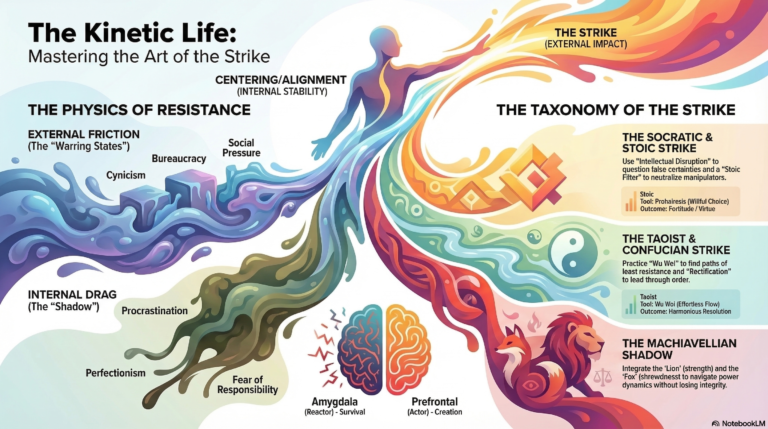
To understand impact, we have to analyze the Dual-Resistance Model. When you decide to move from “thinking” to “doing,” you encounter two distinct types of friction:
- External Friction: This is the “Warring States” environment of 2026. It is the cynical coworker who mocks your ambition, the bureaucratic red tape that strangles your project, the geopolitical anxiety that makes long-term planning feel futile, and the crushing social pressure to conform to the “reactive” average. The world acts like a non-Newtonian fluid; the more force you apply to change it, the more it hardens against you.
- Internal Drag: This is the “Shadow” of the Center. It manifests as procrastination, perfectionism, and what psychologists call the “Upper Limit Problem.” We often self-sabotage not because we fear failure, but because we are terrified of the responsibility that comes with magnitude. We pull our punches to stay within the comfortable boundaries of our old, uncentered selves.
Viktor Frankl, famously spoke of the space between stimulus and response. Impact is the architecture we build within that space. It is the transition from being a “Reactor” (the Amygdala-driven survivalist) to being an “Actor” (the Prefrontal-driven creator). Centering gives you the stability to hold the bow; Impact is the courage to let the arrow go, knowing that once it leaves your hand, it is subject to the winds of fate.
II. The Socratic Agon: Impact as Intellectual Disruption
When we think of “Impact,” we often imagine a physical or economic force. But Socrates, the gadfly of Athens, practiced the Intellectual Strike. He didn’t build monuments or command armies; he shattered the invisible cages of false certainty.
Socrates operated through the Agon—a Greek term for a struggle, contest, or “the agony of the soul.” His theory of “Midwifery” suggests that impact isn’t about winning an argument or imposing your ideology on others; it’s about helping others deliver the truth that is already buried within them. However, as any midwife knows, birth is a messy, high-friction, and often painful process.
External Resistance: The Angry Crowd
In his Apology, Socrates faced the ultimate external resistance: a death sentence from an Athenian jury. He didn’t yield, soften his tone, or apologize for his “Alignment.” His impact was found in his refusal to prioritize survival over integrity. He realized that a “Centered” soul is more valuable than a living body.
In 2026, the “Angry Crowd” is digital and ubiquitous. It manifests as the echo chambers of social media, “cancel culture,” and the “Double Ignorance” of corporate environments where everyone is pretending to know what they are doing. The Socratic Strike in a modern context is the “Strategic Disruption.” It is the courage to ask the “uncomfortable question” in a boardroom where everyone is nodding in agreement. It is the act of stopping a flurry of reactive, cortisol-fueled meetings to ask: “What foundational belief are we assuming is true that might actually be a lie?” This causes social friction, but it is the only way to “Rectify” a misaligned environment.
III. The Stoic Paradox: Fortitude Against Manipulation and Inertia
Stoicism provides the most battle-tested toolkit for handling the friction of the strike. Epictetus, born into slavery and physically disabled, taught that our primary focus must be our Prohairesis—our moral purpose or faculty of choice.
Handling External Resistance: The Manipulator
One of the greatest fears regarding “Impact” is the presence of manipulative people. We worry that our “Arrow” will be hijacked or redirected by someone else’s ego. The Stoic answer is the Stoic Filter. Marcus Aurelius viewed difficult people as natural phenomena—no more “evil” than a thunderstorm or a rocky path.
Aurelius practiced Sympatheia—the understanding that we are all part of a single, interconnected organism. When someone tries to manipulate or provoke you, the Stoic sees them as being in a state of “Limbic Hijack.” They are sick, not just “bad.” By remaining a “Pillar of Reason,” your impact becomes a grounding force. You don’t influence the manipulator by out-maneuvering them with clever tricks; you influence them by refusing to play the game, effectively forcing them to meet you on the level of the “Prefrontal Cortex” or lose their relevance entirely.
Handling Internal Resistance: The Procrastination Trap
Internal drag often manifests as the “sophisticated procrastination” of the intellectual. We tell ourselves we aren’t “centered enough” or “aligned enough” to take the big leap. Stoics bypassed this through the Morning Review. They didn’t wait to feel “motivated”—which is a fickle emotion—they looked at the day from the “View from Above.”
They used Premeditatio Malorum (the premeditation of evils) as a kinetic driver. By imagining the absolute worst-case scenario—failure, bankruptcy, public embarrassment—and realizing that their “Mountain” would still stand, they stripped the internal fear of its power. Procrastination dies when you realize that the discomfort of the strike is a temporary itch, while the rot of an unexecuted arrow is a permanent wound to the soul.
IV. The Tao of Flow: Navigating the Wall of Resistance
If the Stoics teach us how to stand firm against resistance, Lao Tzu teaches us how to move through it. In the Tao Te Ching, we find the theory of the Fluid Strike.
Lao Tzu argued that “the softest thing in the universe overcomes the hardest.” When you encounter a “Wall” of external resistance—a bureaucratic stalemate, a toxic family dynamic, or a stalled creative project—the “Centered” person does not collide with the wall with brute force. They saturate it like water. This is Wu Wei, or “effortless action.”
The Practice of Evasion and Saturation
Tying resistance to Taoism means recognizing when “Force” is a misaligned tool. If you are pushing against a problem and the friction is generating nothing but heat and exhaustion, you are using “Crooked Energy.” The Taoist Strike is the art of finding the “Line of Least Resistance.”
In a leadership context, this means moving away from “Command and Control” micromanagement, which creates immense resistance and resentment. Instead, the Taoist leader creates the conditions where the team can find their own “Flow.” You don’t “force” the impact; you remove the obstacles and let the natural gravity of the goal do the work. It is the realization that sometimes the most impactful thing you can do is to stop pushing and start flowing.
V. The Machiavellian Shadow: Power, Means, and the Self
We cannot discuss Impact in a world of “wars and rumors of war” without addressing the Shadow. To make a real strike in the world of human affairs is to deal with power. This brings us to the most misunderstood figure in political philosophy: Niccolò Machiavelli.
The Realpolitik of the Soul
Machiavelli is often unfairly maligned as a teacher of cruelty, but he was actually a teacher of efficacy. He understood that in a “Warring States” environment, a leader who is “all Mountain and no Fox” will be dismantled by those who have no center.
The Shadow Strike involves the radical honesty of acknowledging that manipulation and power dynamics exist. Carl Jung taught that we must integrate our Shadow—our capacity for aggression, cunning, and self-interest—to become “whole.” If you pretend you don’t have a “will to power,” you don’t become a saint; you become a victim. Worse, your “repressed” power will eventually leak out in passive-aggressive, toxic ways.
The Lion and the Fox
The challenge is the “Jungian Warning” of Inflation. When our impact becomes an ego-trip, we lose our Center. We begin to use people as “Means” to our ends rather than “Ends” in themselves.
The “Machiavellian Mean” is to be the Lion (unshakeable and strong) and the Fox (shrewd and aware of traps). You use “Strategic Influence” to protect the “Good,” but you never let the “means” warp the “Arrow” of your ultimate integrity. You acknowledge the dirt on the ground without letting it stain your soul. You integrate the “Fox” so you can recognize manipulation in others and navigate around it, keeping your “Arrow” pointed at the target of virtue.
VI. The Confucian Rectification: The Gravitational Strike
Confucius believed that social and political chaos was a result of “Crooked Names”—people claiming to be “Leaders,” “Parents,” or “Friends” but failing to act according to the reality of those titles. His answer was Zhengming, or the Rectification of Names.
The Strike of Order
Confucian Impact is not a sudden explosion; it is a Gravitational Strike. When you “Rectify” yourself through Li (Ritual), you create a localized field of order that others are naturally drawn to.
Consider a dysfunctional household or a chaotic team. The person with the most impact isn’t the one shouting the loudest; it’s the one who maintains their “Center” and “Alignment” with such consistency that it becomes awkward for others to remain misaligned. Your personal “Ritual of Order” (your Morning Li) acts as a spatial anchor. External resistance to your influence often melts away when people see that your “Name” (who you say you are) and your “Reality” (how you actually behave) are a perfect, 1:1 match. You lead by “Rectifying” the environment through your own unshakeable conduct.
VII. The Kinetic Feedback Loop: The Psychology of the Strike
Modern psychology, specifically Mihaly Csikszentmihalyi’s theory of Flow, provides the biological biofeedback for the strike.
Impact is a feedback loop. When you strike, you get data. If you miss the target, that is not a moral failure; it is a diagnostic signal. It tells you that your “Alignment” was off or your “Mountain” wasn’t stable. Procrastination is essentially a fear of this feedback. We would rather stay “potentially perfect” in the safety of our imaginations than be “actually flawed” in the reality of the world.
Overcoming the “Internal Amygdala”
To bypass the internal resistance of the “Amygdala Hijack,” you must use the “90-Minute Strike.” This is the practice of “Monotasking” or “Deep Work.” By committing to one high-friction task without interruption, you train your brain to stay “Centered” even when the “External Friction” (emails, notifications, noise) is high.
When you complete a successful strike, your brain releases a surge of serotonin and dopamine. This is the biological “Recovery” we need. It clears the “Cortisol Trap” of the reactive life and prepares the “Mountain” for the next day’s arrows. Success, in this sense, is addictive in the best way—it builds the neural pathways of the “Observer” and the “Actor.”
VIII. The Kantian Impact: The Universal Straightedge
Finally, we apply the “Universal Law” of Immanuel Kant. Kant was a man of such extreme alignment that he believed we have a Moral Duty to make an impact. To sit in a “Mountain” of static peace while your community suffers or your potential withers is not virtue; it is a moral failure.
The Test of the Strike
Before you make a “Machiavellian” move or a “Socratic” disruption, run it through the Categorical Imperative: “If everyone on earth used the exact tactic I am using right now, would the world flourish or collapse?”
If your “Impact” depends on a deception that cannot be universalized, your arrow is crooked. Kantian alignment ensures that your strike is sustainable and ethical. It reminds us that we must treat every person affected by our strike as an “End in themselves,” never merely as a stepping stone or a “tool” to reach our “Target.” True impact is the increase of the “Universal Good.”
IX. The Unified Field of Impact: A General Consensus
While the thinkers we have explored emerge from vastly different eras and cultures, a singular consensus emerges when we synthesize their views on Impact. To have a kinetic life is to realize that Influence is the byproduct of Integrity. Whether it is the Taoist finding the path of least resistance, the Stoic building an internal citadel, or the Socratic agitator dismantling ignorance, they all agree that effective action in the world is impossible without a coherent internal architecture. Impact is not something you force upon the world; it is something that occurs when a Centered and Aligned individual encounters reality.
The “General Consensus” of the Kinetic Life can be summarized thus: The world resists the Reactor, but it orbits the Actor. When you move from a state of “Amygdala Hijack” (Reaction) to a state of “Purposeful Intent” (The Strike), the nature of your friction changes. It shifts from being a destructive force that wears you down to being the very “lift” that allows your arrow to fly. Your Impact is ultimately the external shadow of your internal Mountain.
Table 1: Taxonomy of the Strike
| Perspective | Metaphor for the Strike | Primary Tool | Target Outcome |
| Socratic | Midwifery / Gadfly | The Elenchus (Questioning) | Intellectual Liberation |
| Stoic | The Archer | Prohairesis (Willful Choice) | Fortitude / Virtue |
| Taoist | Water Saturating Rock | Wu Wei (Effortless Flow) | Harmonious Resolution |
| Confucian | Gravitational Pull | Li (Ritual) / Zhengming | Social Rectification |
| Machiavellian | The Lion and the Fox | Strategic Realpolitik | Stability / Efficacy |
| Kantian | The Straightedge | Categorical Imperative | Universal Good |
| Flow | The Kinetic Loop | Deep Work / 90-Min Sprints | Peak Performance |
Table 2: Comparative Analysis of Resistance
| Strategy | Handling External Friction (The World) | Handling Internal Drag (The Self) | Handling Manipulation |
| Resistance | Collision & Endurance | Procrastination & Fear | Victimhood / Reaction |
| Stoicism | Perception Shift (Filter) | Memento Mori (Focus) | Sympatheia (Empathy) |
| Taoism | Fluid Evasion (Flow) | Release of “Trying” | Redirection of Energy |
| Socratic | Interrogation of Norms | Interrogation of Fears | Exposing the Ignorance |
| Confucian | Structural Ritual (Order) | Habitual Discipline | Rectification of the Relationship |
| Machiavellian | Strategic Adaptation | Realpolitik Assessment | Integration of the “Fox” |
X. Synthesis: The Unshakable Vector
Impact is the ultimate proof of the human spirit. It is the realization that between the “Wars and Rumors of War,” there is a life to be lived and a contribution to be made.
To live the Kinetic Life is to be the Balanced Archer:
- You have the Mountain (The Center) that ensures you don’t break when the world pushes back.
- You have the Arrow (The Alignment) that ensures your actions have a meaning beyond mere survival.
- You have the Strike (The Impact) that ensures you aren’t just a spectator watching the world turn.
The world will provide the friction. Your ego will provide the drag. Power will provide the temptation. But the “Unshakable Vector” is found when you realize that the friction is the very thing that allows the arrow to fly. Without the wind, there is no lift. Without the resistance of the target, there is no impact.
Be the Mountain for your peace. Be the Arrow for your purpose. But for the world’s sake, be the Strike.
References & Further Reading
- Aurelius, Marcus. Meditations. (The Pillar of Reason and Sympatheia).
- Csikszentmihalyi, Mihaly. Flow: The Psychology of Optimal Experience. (Impact as Biofeedback).
- Confucius. The Analects. (Zhengming and the Rectification of Names).
- Epictetus. The Enchiridion. (The Theory of the Archer and Prohairesis).
- Frankl, Viktor. Man’s Search for Meaning. (The Space Between Stimulus and Response).
- Jung, Carl. The Undiscovered Self. (Shadow Integration and the Will to Power).
- Kant, Immanuel. Groundwork of the Metaphysic of Morals. (The Categorical Imperative).
- Lao Tzu. Tao Te Ching. (Wu Wei and the Fluid Strike).
- Machiavelli, Niccolò. The Prince. (The Lion, the Fox, and Strategic Efficacy).
- Plato. The Apology of Socrates. (The Intellectual Strike and the Agon).