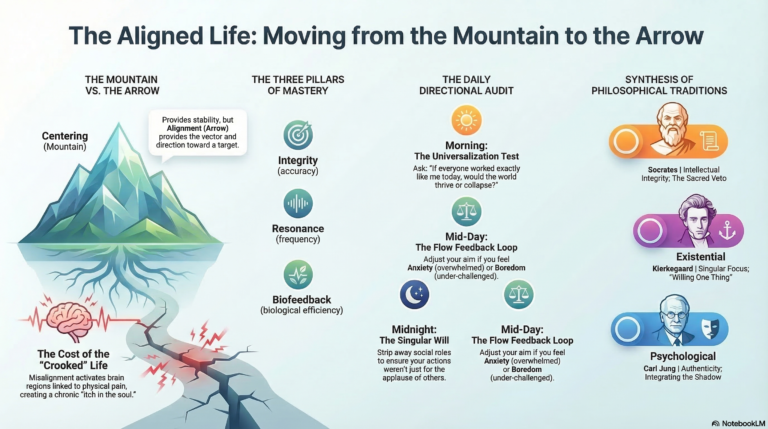
In a previous exploration, we discussed the importance of being “Centered.” We looked at the human psyche as a mountain—a massive, stable structure that remains unshakeable even when the winds of economic instability, digital noise, and geopolitical stress howl around it. Being centered is about internal stability; it is the “Inner Citadel” that protects your peace. It is a defensive posture, a way of ensuring that the world cannot break you. But as vital as that stability is, it is only half of the equation for a flourishing life. If being centered is the Mountain, then being Aligned is the Arrow.
A mountain stays where it is. It is a masterpiece of endurance, but it lacks a destination. An arrow, however, is a masterpiece of intent. An arrow has a vector—a specific direction and a piercing magnitude. You can be the most centered, calm person in the world, sitting perfectly still in a state of Zen-like peace, and yet be pointed in the wrong direction. You can be stable while standing on a path that leads to a cliff. Alignment is the active art of ensuring that your internal values, your daily actions, and your ultimate goals are all stacked on top of one another, pointing toward a singular, meaningful target. While centering keeps you from falling, alignment keeps you moving toward the “Good.”
When we are misaligned, we experience a specific, gnawing kind of suffering. It isn’t the sharp, sudden panic of an “Amygdala Hijack” that we feel when we lose our center. Instead, misalignment feels like a low-grade, chronic “itch” in the soul. It is the feeling of being a hypocrite, or the exhaustion of wearing a social mask that doesn’t quite fit your face. It is the friction of a life where your “Yes” doesn’t match your heart, and your “No” is strangled by social expectation. To live an aligned life is to remove that friction, converting the energy you usually spend on internal conflict into the kinetic energy of purpose. When you are aligned, the wind actually helps you fly faster, rather than blowing you off course.
The Neurobiology of Dissonance (Hidden Cost of the “Crooked” Life)
Before we can find our arrow’s true path, we have to understand the physical and neurological cost of being “crooked.” In modern psychology, this state is known as Cognitive Dissonance. This theory, pioneered by Leon Festinger in the 1950s, suggests that humans have an evolutionary drive to hold all our attitudes and behaviors in harmony. When there is a discrepancy between what we believe and what we do, our biology registers it as a crisis.
Research shows that cognitive dissonance actually activates the dorsal anterior cingulate cortex and the insula—the exact same regions of the brain that process physical pain and the sting of social exclusion. When you claim to value honesty but find yourself “fudging” numbers at work, or when you claim to value family but spend your evenings distracted by a screen, your brain registers that misalignment as a physical “discomfort” that needs to be scratched. It is a signal that your internal “hardware” is fighting your external “software.”
The danger lies in how we handle this pain. Because the brain is an organ designed for efficiency, it often chooses the path of least resistance to stop the discomfort: rationalization. We tell ourselves clever lies to make the crooked arrow look straight. We say, “I’m only doing this job for the money so I can be happy later,” or “I know I’m being dishonest, but the system is rigged anyway.” These rationalizations act like a local anesthetic—they dull the pain of the “itch,” but they don’t fix the misalignment. Over years, this chronic dissonance leads to “Moral Injury,” a state where we lose trust in ourselves. Alignment is the radical refusal to rationalize. It is the commitment to fixing the trajectory of the arrow rather than lying about where it is headed.
The Intellectual Vector (Socrates, the Daimonion, and the Sacred Veto)
The journey of alignment begins with the intellect, and no one interrogated the intellect more fiercely than Socrates. Socrates lived in the bustling, noisy markets of Athens, a place not unlike our modern social media landscape, filled with people shouting opinions they hadn’t actually thought through. While he is famous for the “Socratic Method” of questioning others, his most personal alignment tool was something he called his Daimonion.
This was an internal “divine sign” or voice that Socrates claimed to have heard since childhood. What makes the Daimonion fascinating is that it was purely “apotreptic”—it never told him what to do; it only ever spoke to tell him “No.” It was an internal veto that triggered whenever he was about to take an action that would compromise his integrity. This provides us with our first ritual of alignment: The Sacred Veto. In a world that constantly screams “Yes” to every distraction and opportunity, alignment often starts with the courage to listen to that internal “No.” It is that sudden, inexplicable gut feeling that tells you a business deal is shady or a social circle is toxic, even if you can’t logically explain it yet.
Socrates also practiced a rigorous “Cross-Examination of the Self.” He believed that alignment was impossible without Intellectual Integrity. His test was simple but brutal: “If I were caught doing this act in the middle of the public square, could I defend the logic of it to a crowd of strangers?” He believed that a man who could not defend his actions with reason was a man whose soul was in “civil war.” For Socrates, a life of alignment was one where the “Private Self” and the “Public Self” were the exact same person. If you have to hide your actions to feel okay, Socrates would argue you are misaligned. True alignment means you are “one man” through and through, from the dark of your bedroom to the light of the marketplace.
The Existential Pivot (Kierkegaard and the Midnight Hour)
Moving from the intellect to the spirit, we encounter Søren Kierkegaard, the father of existentialism. Kierkegaard was obsessed with the idea of “The Individual.” He believed that we lose our alignment because we try to “crowd-source” our purpose. We look at what our neighbors are doing, what the trends are, or what our parents expect, and we try to aim our arrow at their targets.
Kierkegaard’s famous mantra for alignment was: “Purity of heart is to will one thing.” He believed that most human misery comes from “double-mindedness”—the state of trying to serve two masters. Imagine your life as a signal. If you are trying to be a “hard-charging, ruthless executive” while simultaneously wanting to be a “compassionate, soulful presence,” but you haven’t decided which one is your “One Thing,” your signal becomes jammed. You end up being mediocre at both and miserable in the process. Alignment is the existential courage to pick a “North Star” and let everything else—your hobbies, your social life, your spending—organize itself around that point.
Kierkegaard proposed a ritual for this called The Midnight Hour. He argued that every person must have a time of day—symbolized by the absolute silence of midnight—where they strip away all their social roles. In this hour, you are not a boss, a consumer, a parent, or a citizen. You are simply a human standing before the Absolute. It is in this silence that you can determine if you are “Double-Minded.” Are you doing your work for the sake of the work, or for the sake of the status it brings? If there is a secondary motive, your arrow is warped. True alignment requires a “Singular Will” that doesn’t need an audience to feel valid.
The Flow Feedback Loop (Taoist Alignment in Action)
If Kierkegaard provides the “will,” the Taoist tradition and modern psychologist Mihaly Csikszentmihalyi provide the “feel.” They suggest that alignment isn’t just a heavy philosophical concept; it’s a biological state called Flow. In this context, Flow acts as the ultimate Biofeedback Loop for Alignment.
Imagine you are an archer. If the arrow is too heavy for your bow, your muscles will shake with Anxiety. If the arrow is too light, you will release it with Boredom and indifference. In both cases, the arrow misses the target because it isn’t aligned with the “nature” of the bow. Alignment is the “Sweet Spot” where your internal skills perfectly match the external challenge.
When you are in Flow, your “Ego”—the part of you that worries about the past or fears the future—literally vanishes. You become the act itself. This is what the Taoists call “Wu Wei” (effortless action). It is the state of being so aligned with the “Way” (the Tao) that you no longer feel like you are “trying.” If you find yourself consistently feeling Anxiety, it is a biological signal that your arrow is pointed at a target that is currently beyond your nature; you are trying to be someone you aren’t yet. If you feel Boredom, you are pointed at a target that is beneath your potential. Alignment is the constant, minute adjustment of your “aim” until the friction of self-consciousness disappears and you “become” the arrow.
The Moral Compass (Immanuel Kant’s Universal Straightedge)
While Flow tells us if we are aligned with our skills, Immanuel Kant tells us if we are aligned with the Universe. Kant was a man of such extreme alignment that his neighbors in Prussia reportedly set their watches by the time he took his afternoon walk. He believed that alignment was a matter of logical consistency—a “straightedge” for the soul.
He developed a mental ritual known as the Universalization Test. Before you take any action—especially a questionable one—you must perform a simulation. Ask yourself: “If I make this action a universal law—meaning every human on earth has to do exactly what I am doing right now—would the world still function?”
Consider the “small” misalignment of being five minutes late to everything. If you universalize that, every meeting on earth starts late, every train is behind schedule, and the social fabric eventually tears. Therefore, being “late” is a crooked act. Kantian alignment is about treating your life as a prototype for all of humanity. He also insisted on the “End-in-Itself” test: Are you treating the people in your life as “tools” to get what you want, or as valuable individuals? If you are using a friend to get a job, your arrow is pointed at your own ego, not at the truth. Alignment is the refusal to use others as stepping stones. It is the commitment to a path that stays straight even when no one is watching.
Social and Ritual Alignment (Confucius and the Power of Names)
Confucius believed that you couldn’t have an aligned soul in a chaotic world without Li (Ritual) and Zhengming (The Rectification of Names). For Confucius, alignment was a matter of social and personal “accuracy.” He lived during a time of immense political collapse and concluded that the chaos started because words had lost their meaning.
He argued that if a “Leader” is someone who sacrifices for their people, but the person with the title of “Leader” only takes for themselves, then the “Name” and the “Reality” are misaligned. This create a “leak” in the social fabric that eventually leads to war. His ritual for alignment was The Rectification of the Self. He believed that by ordering your external environment—how you dress, how you organize your desk, how you greet your neighbors—you are training your internal self to be “orderly.”
If you claim to be a “disciplined person” but your home is in total disarray and your promises are constantly broken, Confucius would say you are living a lie. You are a “crooked name.” Alignment is the practice of ensuring that your “Name” (who you say you are) and your “Reality” (how you actually behave in the small, boring details of life) are a perfect match. He believed that when one person “rectifies” themselves, they become a pillar that helps align everyone around them.
The Archetypal North Star (Carl Jung and the Shadow)
Carl Jung, the Swiss psychiatrist, looked at alignment through the lens of Individuation. He believed we lose our alignment because we try to be “perfect” instead of “whole.” We take all the parts of ourselves we don’t like—our capacity for anger, our secret greeds, our “weird” traits—and we shove them into a basement called the Shadow.
When we do this, our “Arrow” becomes physically unbalanced. It develops a “wobble” because we are ignoring half of our weight. We then “project” our shadow onto other people. If you find yourself constantly, irrationally angry at a coworker for being “arrogant,” Jung would suggest that you are misaligned with your own repressed need for confidence. You are at war with them because you are at war with a part of yourself.
Jung’s test for alignment was Synchronicity. He observed that when an individual finally integrates their shadow—acknowledging their capacity for both darkness and greatness—the external world starts to respond with meaningful coincidences. It’s as if the universe “recognizes” that your arrow is finally flying straight and the “drag” of your repression has vanished. Alignment is the end of the internal civil war. It is the moment you stop trying to be the “Persona” (the mask) and start being the “Self” (the whole human).
The Self-Actualization Pyramid
Abraham Maslow brought a practical, biological perspective to alignment. He discovered that when people are misaligned with their true potential, they develop what he called Metapathologies. These aren’t just typical mental illnesses; they are “sicknesses of the soul” like chronic cynicism, apathy, and a sense of pervasive meaninglessness.
Maslow’s alignment test is based on the Hierarchy of Needs. He famously said, “What a man can be, he must be.” This is the “Imperative of Alignment.” If you have a profound talent for music but you spend forty years selling insurance because it’s “safe,” you are in a state of chronic misalignment. You are fulfilling your “Lower Needs” (security) while completely ignoring your “Higher Needs” (actualization).
The “Signal” of Maslow’s alignment is the Peak Experience. These are moments of intense joy, awe, and “Is-ness” where you feel that life is exactly as it should be. If you haven’t had a peak experience in years, it is a diagnostic signal that you are misaligned with your potential. You are playing it safe while your soul is starving for the target it was meant to hit. Alignment is the courage to climb the pyramid even when the higher steps look scary and “unproductive” to the rest of the world.
Stoic Fortitude (The Archery of the Will)
Finally, we return to the Stoics for the “Battle-Tested” version of alignment. The Stoics, like Marcus Aurelius and Epictetus, used a concept called Prohairesis—the faculty of moral choice. They had a very specific way of looking at the “Arrow” that focused entirely on the archer, not the target.
A Stoic archer does everything in their power to hit the target. They choose the best bow, they fletch the best arrow, and they train their muscles to be perfectly steady. This is the Alignment of the Will. But, the Stoics realized a profound truth: once the arrow leaves the bow, the result is no longer in their control. A sudden gust of wind, a bird flying past, or a moving target could cause a miss.
If the archer ties their happiness to hitting the target, they are misaligned with reality, because they are trying to control the uncontrollable. The Stoic “Alignment Ritual” was the Evening Review. Every night, Marcus Aurelius would ask: “Where did I let an external event move my internal will? Where did I get angry at the wind for blowing?” Alignment, for the Stoic, is the “Straightness of the Soul.” You are aligned when your happiness depends only on the “straightness” of your aim, not on where the arrow lands. This is the ultimate freedom—to be perfectly aimed in a world of total chaos.
The Unified Will (The End of Internal Friction)
When we look across these nine frameworks, from the markets of Athens to the psychology labs of the 20th century, a singular theme emerges: The Unified Will. In every tradition, the greatest obstacle to alignment is “Internal Friction.” We are fragmented beings. One part of us wants to be healthy; another part wants the sugar. One part wants to be honest; another part wants to be liked. One part wants to build a legacy; another part wants to watch six hours of television. This internal “Civil War” is what makes us feel heavy and slow. It makes our “Arrow” tumble through the air instead of slicing through it.
To have a “Unified Will” is to move from Internal Conflict to Internal Singularity.
- For Socrates, this was Integrity (The Public and Private match).
- For Kierkegaard, this was Purity of Heart (Willing one thing).
- For Jung, this was Individuation (The Shadow and the Light match).
When your Will is unified, the energy that was previously wasted on guilt, hesitation, and self-doubt is suddenly released. This is why aligned people often seem to have “superhuman” energy and a “lucky” streak. They aren’t actually stronger or luckier; they just aren’t fighting themselves anymore. They have removed the “Internal Drag” from their lives. Their arrow has no friction.
Unifying Theories of Alignment (The Three Pillars)
If we were to build a single “Master Theory” of alignment to guide a modern life, it would consist of these three pillars:
- The Integrity Theory (The Fit): Alignment is a measurement of “Accuracy.” It is the degree to which your “Internal Map” (who you think you are) matches the “External Territory” (how you actually behave). If the map and the territory don’t match, you will get lost, no matter how hard you run.
- The Resonance Theory (The Frequency): Alignment is like music. When two strings on a guitar are tuned to the same frequency, they “resonate”—one will start to vibrate when the other is plucked. Alignment is when your individual “frequency” (your daily habits) resonates with the “Universal Frequency” (Truth, Justice, and Love). When you are “in tune,” life feels musical and effortless.
- The Biofeedback Theory (The Efficiency): Alignment is a biological state of high efficiency. Misalignment is “Biological Waste.” When you are misaligned, your body produces excess cortisol and your brain burns extra glucose trying to manage the stress of hypocrisy. Alignment is the optimization of the human machine. It is the state where you burn the least amount of fuel for the most amount of impact.
The Mental Energy Audit: Designing Your Aligned Day
To move from the Mountain to the Arrow, you must treat alignment not as a one-time decision, but as a daily “Archery Practice.” Here is how you can perform a “Directional Audit” from sunrise to sunset:
- Morning (The Socratic/Kantian Check): Before you open your email, run your “To-Do” list through the Universalization Test. “If everyone on my team worked the way I am about to work today, would the company thrive or collapse?” Aim your arrow at the “Universal Good” before the world tries to aim it for you.
- Mid-Day (The Flow/Taoist Check): Monitor your internal “Feeling” during your peak working hours. Are you experiencing Anxiety or Boredom? Adjust your tasks, increase the challenge, or sharpen your focus until you find the “Zero Friction” state of Flow.
- Midnight (The Kierkegaardian Review): Sit in absolute silence for ten minutes. Strip away your titles. Ask: “Was I ‘Double-Minded’ today? Did I do things for the applause of the crowd, or for the sake of the ‘One Thing’ I truly value?”
- Night (The Stoic Review): Review the “Archery” of the day. Did you keep your hand steady even when the wind of bad news blew? Forgive the missed targets, but demand a straighter, more intentional aim for tomorrow morning.
The Holistic Vector: A Synthesis Table
| Dimension | Tradition / Philosopher | Theoretical Goal | Practical Outcome |
| Intellectual | Socrates | To eliminate “Hypocrisy” | Intellectual Integrity; The Sacred Veto |
| Existential | Kierkegaard | To “Will One Thing” | Singular Focus; Freedom from Role-Playing |
| Directional | Taoism / Flow | To achieve “Wu Wei” | Zero-Friction Action; Biofeedback |
| Moral | Immanuel Kant | To follow the “Universal Law” | Moral Consistency; Global Responsibility |
| Social | Confucius | To “Rectify the Name” | Social Accuracy; External Order |
| Psychological | Carl Jung | To “Integrate the Shadow” | Authenticity; Ending Internal Projection |
| Potential | Abraham Maslow | To “Self-Actualize” | Peak Experiences; Meaningful Work |
| Willful | Stoicism | To master “Prohairesis” | Internal Control; Resilience to Outcome |
Final Word: The Flight of the Arrow
Being Centered is your foundation. It is the peace that allows you to stand in the storm without breaking. But Alignment is your destiny. It is the movement that turns a peaceful life into a meaningful one. The mountain is beautiful, but the world is changed by the arrow.
The world does not need more people who are just “calm.” The world needs people who are Aligned—people whose actions are so consistent with their values that their very presence acts as a “Rectification” of the environment around them. When an aligned person walks into a room, the “crookedness” of the world starts to straighten out.
You will miss the target today. You will find yourself rationalizing a lie, seeking cheap approval, or letting your ego aim your bow. That is the human condition. The goal is not to be a perfect arrow that never misses. The goal is to be a master archer who is constantly, ruthlessly, and lovingly adjusting their aim.
Be the Mountain for your own peace, but be the Arrow for the world’s sake. Your alignment is the only thing that can turn the “wars and rumors of war” into the material for a life of unshakable integrity.
References & Further Reading
- Aristotle, Nicomachean Ethics (The habit of virtue and the aim of life).
- Festinger, Leon, A Theory of Cognitive Dissonance (The psychological cost of misalignment).
- Kierkegaard, Søren, Purity of Heart is to Will One Thing (The existential focus of the soul).
- Kant, Immanuel, Groundwork of the Metaphysic of Morals (The Categorical Imperative).
- Confucius, The Analects (Zhengming and the Rectification of Names).
- Jung, Carl, The Undiscovered Self (The integration of the Shadow and the Self).
- Maslow, Abraham, Toward a Psychology of Being (The alignment of potential and reality).
- Plato, The Apology of Socrates (The Daimonion and Intellectual Integrity).
- Csikszentmihalyi, Mihaly, Flow: The Psychology of Optimal Experience (The biofeedback of alignment).
- Epictetus, The Enchiridion (The training of the Prohairesis).