The Unshakable Center: Ancient Wisdom and Modern Psychology for Holistic Stability
In an era defined by “wars and rumors of war”—a landscape of economic instability, digital overwhelm, and constant geopolitical shifts—the human psyche is under unprecedented pressure. For many, life feels like being caught in a permanent storm. We are reactive rather than intentional, drifting from one crisis to the next. To live holistically in such a world, one must develop “The Center.”
Being centered is not a state of static peace or the absence of conflict. Rather, it is the dynamic ability to maintain an internal architecture that external chaos cannot reach. It is the “Mountain in the Storm.” By synthesizing the insights of ancient philosophers and modern psychologists, we can build a fortress of the self that remains stable regardless of the weather outside. This stability is the prerequisite for leadership, creativity, and meaningful relationships.
Part I: The Biological Breakdown (The Cost of No Center)
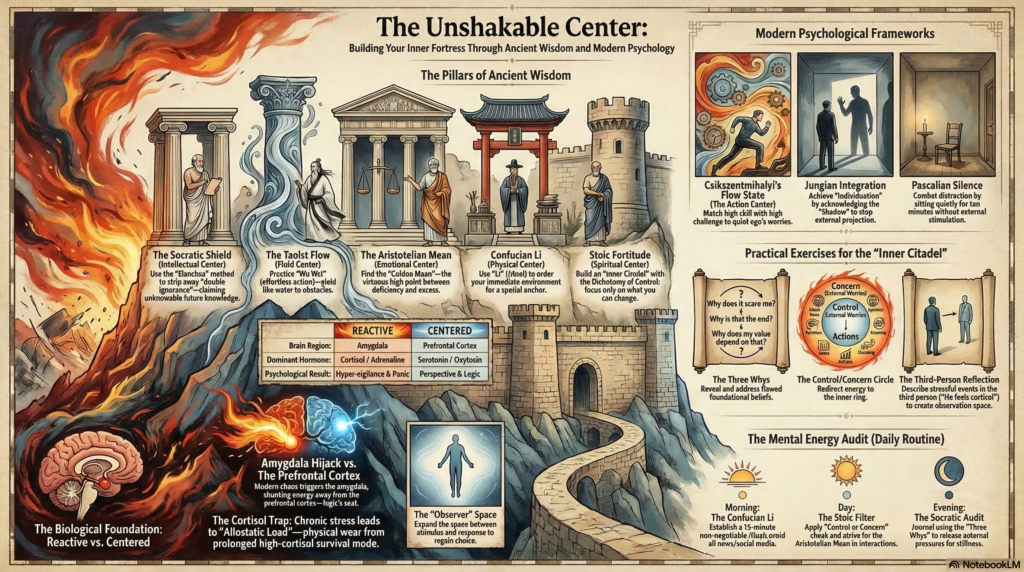
Before we can build a center, we must understand why we lose it. From a neurobiological perspective, modern chaos triggers what psychologists call an Amygdala Hijack. The amygdala is the brain’s “smoke detector,” an almond-shaped cluster responsible for the fight-or-flight response. When we are bombarded by stressful news or uncertain economic data, this primitive part of the brain takes over, effectively “shunting” energy away from the prefrontal cortex—the seat of logic, values, and long-term planning.
This is not merely a psychological feeling; it is a physiological reallocation of resources. The body prioritizes survival over sophistication. In a state of hijack, our ability to perceive nuance vanishes, and we begin to see the world in binary terms: friend or foe, safe or dangerous.
The result is a chronic “Cortisol Trap.” Cortisol, the stress hormone, is vital for short-term survival (like escaping a predator) but toxic when it remains at high levels for months or years. This leads to “Allostatic Load”—the wear and tear on the body that accumulates when an individual is exposed to repeated or chronic stress. It results in decision fatigue, sleep disruption, and a diminished capacity for empathy. When we are uncentered, we sacrifice our long-term health and moral clarity for the illusion of short-term survival.
| State | Primary Brain Region | Dominant Hormone | Psychological Result | Physiological Impact |
| Reactive | Amygdala (Limbic System) | Cortisol / Adrenaline | Hyper-vigilance, Panic, Short-termism | Increased heart rate, suppressed immunity |
| Centered | Prefrontal Cortex | Serotonin / Oxytocin | Perspective, Logic, Long-term Vision | Lowered blood pressure, enhanced recovery |
Practical Exercise: The 60-Second Pulse Check
Set a timer for 60 seconds. Close your eyes and focus solely on the physical sensations of your breath. As you inhale, notice the coolness of the air; as you exhale, notice the warmth. If your mind drifts to a worry, acknowledge it as a “data point” and return to the breath. This exercise trains the prefrontal cortex to regain command over the amygdala, identifying the “internal vibration” of stress before it turns into a full-scale reactive spiral.
Part II: The Socratic Shield (The Intellectual Center)
The first layer of the center is intellectual. Socrates famously stated that “the unexamined life is not worth living,” but for the centered individual, we might add: the unexamined fear is not worth fearing. Socrates operated in the bustling markets of Athens, not in a quiet monastery. His theory, known as the Elenchus or the Socratic Method, was a tool of cross-examination designed to strip away false certainties.
Socrates believed that most human suffering and panic stem from “double ignorance”—thinking we know something when we actually do not. When we hear a rumor of economic collapse and panic, Socrates would argue we are “claiming to know the future,” which is an intellectual impossibility. By admitting our ignorance and questioning the “logic” of our fear, we dismantle the power that fear has over us.
He famously demonstrated this even as he faced his own death sentence, questioning his friends’ grief until they realized that fearing death was illogical, as no one knows what death truly is. The “Socratic Shield” is the refusal to accept any thought as “true” just because it is loud or frightening.
Practical Exercise: The Three Whys
Write down a current fear (e.g., “I might lose my job”).
- Ask yourself “Why does this scare me?” (e.g., “Because I won’t be able to pay my bills”).
- Ask “Why is that the end of my story?” (e.g., “Because I’ll lose my status and comfort”).
- Ask “Why does my value depend on that status?” Usually, by the third “Why,” you reach a foundational belief—often a flawed one—that you can address with logic, stripping the initial panic of its power and revealing a path for action rather than paralysis.
Part III: The Taoist Flow (The Fluid Center)
If Socrates provides the shield, Lao Tzu provides the ability to move. In the Tao Te Ching, Lao Tzu presents the theory of Wu Wei, often translated as “non-doing” or “effortless action.” This is not an argument for laziness; it is a sophisticated theory of alignment. Lao Tzu observed that the world is in a constant state of flux (the Tao). Trying to resist this flux is like trying to stop a river with your bare hands—it is exhausting and ultimately futile.
The Taoist “Center” is modeled after water. Water is the softest substance, yet it can wear down the hardest rock. It does not argue with the terrain; it flows over, under, or around it. Lao Tzu lived during the “Warring States” period of China—a time of immense chaos. His “fluid center” allowed him to navigate political upheaval without becoming spiritually brittle.
He introduced the concept of Pu—the “Uncarved Block.” This represents our original, centered nature before the world’s labels, expectations, and panics try to shape us. To be centered in the Taoist sense is to remain “uncarved” by the opinions of others, maintaining your essence while flowing with the circumstances.
Practical Exercise: The “Yield and Overcome” Journal
At the end of the day, identify one conflict where you “pushed back” with force (an argument, a traffic frustration, a demanding email). Imagine how that same situation would have looked if you had “yielded” like water—accepting the energy of the obstacle and redirecting it rather than colliding with it. Practice this visualization to build a more flexible, less fragile response for the next day.
Part IV: The Aristotelian Mean (The Emotional Center)
Aristotle’s approach to the center was deeply practical and grounded in the concept of Eudaimonia (human flourishing). In his Nicomachean Ethics, he proposed the Doctrine of the Mean. He argued that every virtue is a “mean” between two vices: one of deficiency and one of excess. For Aristotle, the centered individual is a master of “The Mean.”
He taught that we are what we repeatedly do. Therefore, being centered is not an act, but a habit—a “muscle” developed through Phronesis (practical wisdom). Aristotle didn’t believe in universal rules for emotions; rather, he believed the “Mean” was relative to the individual and the situation. To be centered is to feel the right emotion, at the right time, toward the right person, for the right reason. This prevents the “Emotional Hijack” by keeping us in the territory of deliberate virtue.
The “Mean” is not a compromise; it is the highest point of excellence. Just as a marksman hits the bullseye by avoiding both the left and right misses, the centered person hits the target of life by avoiding the “cliffs” of emotional extremes.
| Virtue | Deficiency (Vice) | The Golden Mean (The Center) | Excess (Vice) |
| Courage | Cowardice | Bravery | Rashness |
| Temperance | Insensibility | Self-Control | Intemperance |
| Generosity | Stinginess | Magnanimity | Prodigality |
| Truthfulness | Self-deprecation | Honesty | Boastfulness |
| Patience | Submissiveness | Composure | Irascibility (Short temper) |
Practical Exercise: The Extremes Audit
Draw a line with “Deficiency” on one end and “Excess” on the other. Map your current life habits—your work hours, your social media consumption, your fitness, or your emotional openness. Are you working too much (Excess) or avoiding responsibility (Deficiency)? Identifying exactly which “cliff” you are leaning toward allows you to apply the counter-weight necessary to return to the Center.
Part V: The Pascalian Silence (The Existential Center)
Blaise Pascal, a 17th-century polymath and philosopher, explored the “Center” through the lens of existential anxiety. In his work Pensées, he observed that humans are terrified of the “infinite spaces” of the universe and our own mortality. To cope, we engage in Divertissement (diversion)—constant activity, noise, and entertainment meant to drown out the internal silence.
Pascal’s theory was that we lose our center because we are afraid of what we will find if we stop moving. In the modern world, “Divertissement” has taken the form of “doom-scrolling” and the constant checking of notifications. We use “wars and rumors of war” as a high-stakes diversion to avoid the simple reality of being alone with ourselves.
For Pascal, the “Existential Center” is found by confronting the void. He believed that until a person can sit quietly and face their own insignificance, they will always be a slave to external distractions. The center is found when you no longer need the world to entertain you in order to feel “okay.”
Practical Exercise: The Ten-Minute Void
Once a day, sit in a chair with no phone, no book, and no music for ten minutes. This is not a meditation where you try to “achieve” anything. Simply sit. You will likely feel an initial “itch” or anxiety—this is the sound of your uncentered ego protesting the lack of diversion. Observe the itch without scratching it. Wait for the mind to settle like silt in a glass of water.
Part VI: The Confucian Li (The Physical Center)
While many philosophers focused on the mind, Confucius focused on the body and the environment. His theory centered on Li (ritual propriety). Confucius lived during the “Spring and Autumn” period of social collapse and believed that “internal rectitude” (being centered) could only be achieved through external order.
Confucius taught that when a person performs a ritual—be it a tea ceremony, the way they dress, or how they greet a neighbor—they are practicing the “Center.” Rituals act as a “spatial anchor.” By ordering the small things (your desk, your morning, your manners), you create a predictable environment that allows the mind to rest.
He believed in the Rectification of Names—the idea that our words and actions must align with reality. If you call yourself “centered” but your home is in chaos and your promises are broken, you are living a lie. The “Superior Person” (Junzi) is one who is so centered through ritual that they remain a pillar of calm even when the social fabric around them is tearing.
Practical Exercise: The Morning Li
Create a 15-minute morning ritual that is non-negotiable. It could be making your bed to a specific standard, a specific stretching routine, or the ritualized preparation of coffee. This “Li” serves as your daily anchor; no matter what chaotic news breaks during the day, you have already established a “win” and a sense of order. You are signaling to your nervous system that you are in control of your immediate environment.
Part VII: Stoic Fortitude (The Spiritual Center)
Stoicism provides perhaps the most “battle-tested” theory of the center. Epictetus, born a slave, and Marcus Aurelius, the Emperor of Rome, both utilized the Dichotomy of Control. This theory posits that the “Center” is found by creating an “Inner Citadel”—a mental fortress where only things under our direct control are allowed entry.
Aurelius wrote his Meditations while leading Roman legions during the Marcomannic Wars and the Antonine Plague. He remained centered by realizing that his “ruling faculty” (the Hegemonikon) was independent of external events. If he could control his perception of the war, he could maintain his peace.
The Stoics also practiced Premeditatio Malorum (the premeditation of evils). By imagining the worst-case scenarios, they stripped those events of their “surprise factor.” When a rumor of war actually became a reality, the Stoic was ready because they had already “visited” that reality in their mind. They used Amor Fati (love of fate) not just to tolerate chaos, but to embrace it as the very material required to forge a resilient soul.
Practical Exercise: The Control/Concern Circle
Draw two concentric circles.
- In the Outer Circle (Concern), write things you are worried about but cannot change (the global economy, political outcomes, other people’s opinions).
- In the Inner Circle (Control), write what you can actually do today (your work, your attitude, your exercise, your kindness).
When you feel a spike in anxiety, look at your drawing and ask: “Am I bleeding energy into the outer circle right now?” If so, consciously pull your focus back to the inner circle.
Part VIII: The Flow State (The Action Center)
Mihaly Csikszentmihalyi’s theory of Flow brings the concept of the “Center” into the modern world of performance and productivity. He discovered that the most “centered” human experience occurs when we are in a state of autotelic engagement—where the activity is its own reward.
Flow is the “Center in motion.” According to his research, when a task’s challenge is too high, we feel anxiety; when the challenge is too low, we feel boredom. The “Center” is the thin line between these two, where our skill perfectly matches the challenge.
In this state, the “Ego”—the part of us that worries about “wars and rumors of war”—temporarily vanishes. This is not an escape from reality, but a deep immersion in it. Achieving “Flow” regularly is a biological necessity for holistic living; it provides the brain with the recovery it needs from the chronic “reactive” state of modern life.
Practical Exercise: Deep Work Sprints
Choose one difficult task and commit to it for 90 minutes without interruption. No notifications, no tabs open except the work at hand. This practice of “monotasking” builds the psychological muscle required to stay centered during high-pressure situations. You are practicing the art of “Single-Pointed Focus.”
Part IX: The Jungian Integration (The Psychological Center)
Carl Jung’s theory of Individuation is the process of becoming a “whole” person. Jung believed that we lose our center because we repress parts of ourselves into the “Shadow.” When we are uncentered, we project our internal fears and insecurities onto the external world—seeing “enemies” everywhere because we haven’t faced the “enemy” within.
The Jungian “Center” is the Self (with a capital S), which is distinct from the Ego. The Ego is like the captain of a ship, but the Self is the entire ocean, including the weather and the depths. By integrating the Shadow—acknowledging our capacity for fear, anger, and weakness—we stop being “triggered” by external chaos.
A centered person in the Jungian sense is one who has “made the unconscious conscious.” They can observe their own reactions with curiosity rather than judgment. They realize that their reaction to “rumors of war” often says more about their own internal state than it does about the actual geopolitical situation.
Practical Exercise: The Third-Person Reflection
When you are in the middle of a stressful event, try to describe it to yourself in the third person. Instead of saying “I am failing,” say “He is experiencing a difficult moment and feeling a surge of cortisol.” This creates a “Space of Observation” between the “I” (the Self) and the experience (the Ego), allowing the Center to remain intact while the storm passes through.
Summary: The Theme of “The Observer”
While these nine frameworks come from different centuries and cultures, they share a singular, underlying theme: The cultivation of the “Observer” over the “Reactor.” Holistic living is the art of lengthening the space between a stimulus (a rumor, a stressor, a conflict) and your response. Viktor Frankl, a psychiatrist and Holocaust survivor who maintained his center in the most extreme conditions imaginable, famously said: “Between stimulus and response there is a space. In that space is our power to choose our response. In our response lies our growth and our freedom.”
The Mental Energy Audit: Designing Your Unshakable Day
To apply these concepts holistically, one must perform a daily “Energy Audit” to ensure the Center is maintained from sunrise to sunset:
- Morning (The Confucian Li): Order your immediate environment. No news or social media for the first 60 minutes. Use this time to define the “Observer” through meditation or ritual.
- Day (The Stoic Filter): As stressors arise, constantly ask, “Control or Concern?” Act only on the Mean (the high point of virtue) and consciously try to lengthen the space between triggers and reactions.
- Evening (The Socratic Audit): Interrogate the day’s fears. Journal using the “Three Whys” to release external pressures. End the day by “releasing the external,” preparing the mind for sleep as the “Mountain” that remains still while the world turns.
The Holistic Fortress: A Synthesis
| Dimension | Tradition/Philosopher | Theoretical Goal | Practical Outcome |
| Intellectual | Socrates | To eliminate “Double Ignorance” | Clarity in Crisis; Intellectual Humility |
| Emotional | Aristotle | To master the “Doctrine of the Mean” | Emotional Stability and Virtue |
| Spiritual | Stoicism | To build an “Inner Citadel” | Unshakable Fortitude and Peace |
| Physical | Confucius | To order the “Li” (Ritual) | External Grounding and Discipline |
| Action | Csikszentmihalyi | To achieve “Flow” | Productive Focus and Recovery |
| Psychological | Jung | To achieve “Individuation” | Psychological Wholeness and Insight |
| Fluidity | Lao Tzu | To master “Wu Wei” | Flexibility and Resilience |
| Existence | Pascal | To face the Silence | Freedom from Distraction |
Final Word: The center is not a destination you reach and then stay at forever. It is a practice. You will lose your center today, and perhaps tomorrow as well. The goal is not to never lose it, but to become faster at finding your way back to it. Every time you return to the center, you strengthen the neural pathways of the “Observer.” Be the Mountain. Let the storm pass. Your center is the only thing that truly belongs to you.
References & Further Reading
- Aristotle, Nicomachean Ethics (The Golden Mean and Eudaimonia).
- Marcus Aurelius, Meditations (The Inner Citadel and Stoic Fortitude).
- Viktor Frankl, Man’s Search for Meaning (The Space between Stimulus and Response).
- Lao Tzu, Tao Te Ching (Wu Wei and the Fluidity of Water).
- Mihaly Csikszentmihalyi, Flow: The Psychology of Optimal Experience (The Action Center).
- Confucius, The Analects (Li and the Rectification of Names).
- Blaise Pascal, Pensées (Divertissement and the Power of Silence).
- Carl Jung, Modern Man in Search of a Soul (Individuation and Shadow Integration).
- Plato, The Apology of Socrates (The Socratic Method and Intellectual Honesty).